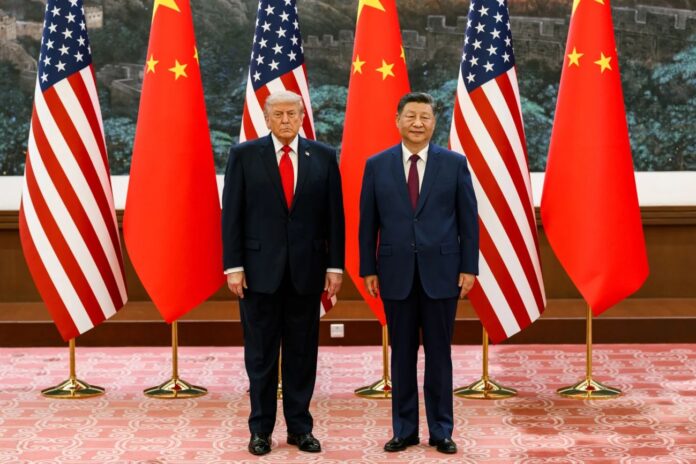
It is important to first map the path to the summit in Beijing. The hegemonic struggle between US unipolarity on the one side and Chinese multipolarity on the other is the defining feature of our age to which all other issues are subordinated and subsumed. It is in this context we must view the wars in Ukraine and Iran. Both were intended to strengthen US hegemony, but both weakened it, not that this balance of forces was evident in Trump’s bellicose statements leading up to the meeting with President Xi.
The war in Ukraine has laboured under two misconceptions. Firstly, that it was a war provoked by Russia instead of by the US and NATO. Secondly, that it was avoidable because it did not serve the interests of US imperialism. The best authority on the causes of the Ukraine war which began in 2014 and had its antecedents in 2008 is Jacques Boyd, a former Swiss intelligence officer seconded to Ukraine prior to the war. Here he explains that it was NATO’s eastward expansion plus Zelensky’s threat to reconquer the Crimea, as well as the constant shelling of the Donbass claiming 14,000 civilian lives since 2015, which in the end provoked the war in Ukraine.
All illusions about the nature of the war are stripped bare when it is recognised that the war was not about Ukrainian sovereignty, but as always, was intended to bring about regime change in Moscow. Hence the failures of the Minsk agreements and the failure of the Istanbul accords, which could have prevented and ended the war.
Which brings us to the second question, how did it further the interests of US imperialism? To answer this, we need to understand the split within US imperialism between the majority faction which saw the defeat of Russia as essential to complete the encirclement of China and the minority faction around Trump which sought to wean Russia away from China thereby isolating China. Why did the minority position fail? It failed because had the US sought to wean Russia away from China, the prize would have needed to be an alignment with Europe. This would have required a European-wide security architecture replacing NATO as well as closer economic integration between Russia and the EU.
This was intolerable to the US. The last thing the US wanted was a strong EU competitor fortified by cheap Russian energy and other industrial inputs. No, Washington’s ambitions were to contain China and keep Europe weak, hence the famous dictum, keep Russia out, Germany down and the US in. This triad could be achieved in only one way – decoupling Russia from the EU and dismembering Russia.
The question that follows, why did the Europeans participate in the decoupling of Russia from the EU? which appeared to be an act of economic self-harm. The answer was once again, China. In survey after survey conducted by consulting firms like KPMG, leaders of German corporations operating in China expressed their fears that growing Chinese competition was going to overwhelm them.
They did not express the same sentiments or fears when asked about their operations in the USA. And yes, it has come to pass; EU car manufacturing, engineering and chemicals have withered in the face of Chinese competition. Thus, when the EU joined up with the US, what appeared to be short-term economic self-harm, was in fact offset by the ambition of seeing China constrained. That the EU has only succeeded in harming itself without the prospect of seeing China constrained is by the by. This is the way that historical plans often fail to materialise.
The harm extends to the US as well. Its grand strategy is in ruins. The only consolation prize is the economic harm it caused in Europe and increasing EU dependency on expensive US energy supplies. This is reminiscent of the US playbook during both 20th century world wars – financially harm spent adversaries such as Britain, while destroying rising adversaries such as Germany and Japan.
But in the 21st century, in terms of China, the US has failed decisively in its mission to undo its rising adversary. The Ukrainian and Iranian war has depleted its advanced arsenals of missiles and interceptors. On the other hand, Russia and Iran have emerged relatively stronger from the conflicts. To underline this and give Trump the finger, only this week Russia launched 1,623 drone and missiles against Ukraine in 24 hours, its heaviest of the war.
In contrast, the CIA now admits, contradicting its own president’s boasts, that Iran retains 70% of their missiles and 75% of their launchers despite a near 40-day bombardment by ‘USrael’. Iran countered with the figure of 120% thanks to Russian and Chinese generosity. It will take years for the US to replenish its arsenal while China streaks ahead with its far larger industrial base. Today, the industrial imbalance between the US and China is around three times larger than the imbalance between the US and Japan at the time of Pearl Harbour.
What should be expected from the summit in Beijing?
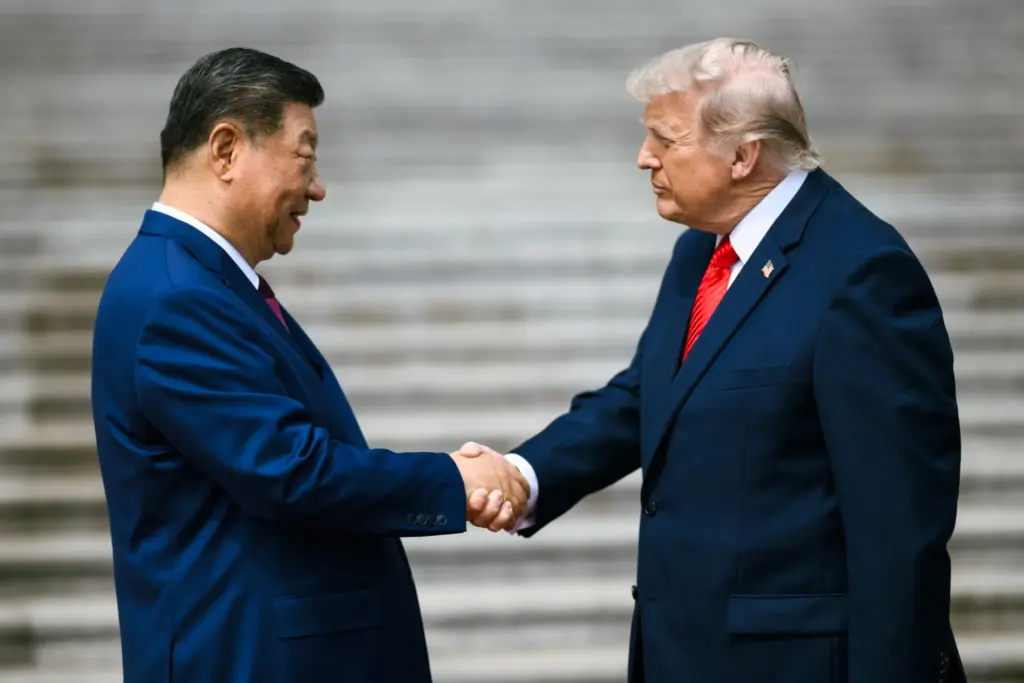
The timing of the attack on Iran was not accidental though it was premature from a military standpoint. Trump had arranged to meet Xi in Beijing at the end of March. Crushing Iran would have reversed the defeat in Ukraine, giving the US the upper hand in its negotiations with the Chinese. The opposite happened. The US strategic setbacks in Iran and the Straits of Hormuz gave the advantage to the Chinese. For the time being the US cannot threaten China militarily.
It is the US, now, rather than the Chinese, who must play for time, time to replenish its arsenals, time to bolster its industries. Hence the redirected emphasis of this trip, the switching from the political to the economic, emphasised by Trump’s excess baggage, the cluster of billionaires accompanying him. The main items on the agenda were more about how to repair economic relations rather than resolving geopolitical issues including Iran and Taiwan.
From his posture, we have Trump backpedalling, adding to his TACO (Trump Always Chickens Out) credentials. No doubt he will ask Xi to help unblock the Gulf, to buy more US goods and so on. But the omens are not good. On his arrival Trump was met by lower-level Chinese officials. The official Chinese media set the tone, giving more coverage and prominence to the visit by the president of Tajikistan than they did to Trump.
As usual the effusive opening statement by Trump was the opposite of what he intended. Here is Trump’s version of calling Xi a friend. “The relationship between China and the USA is going to be better than ever before… We’re going to have a fantastic future together. I have such respect for China, the job you’ve done. You’re a great leader. I say it to everybody. Sometimes people don’t like me saying it, but I say it anyway.”
A planet big enough for China and the US?
Xi’s opening remarks were more grounded and circumspect, acknowledging the transformations occurring while raising concerns. “Whether China and the United States can transcend the so-called Thucydides Trap and create a new normalisation of relations between major powers; whether we can join hands to address global challenges and inject greater stability into the world; whether we can advance the wellbeing of the peoples of our two countries and the future destiny of humanity and jointly create a better future for bilateral relations,” Nevertheless, Xi restated his vision that the planet was big enough for the ‘Great Rejuvenation of the Chinese Nation’ to go hand in hand with ‘Making America Great Again’.
On Taiwan, Xi told the US to behave to avoid conflict. In the joint statement however the issue of Taiwan was omitted. As expected, the US statement following the two and a quarter hour meeting focused on economic matters, while describing the meeting as “good”. There was no hint of triumphalism. How different it would have been had ‘USrael’ crushed Iran beforehand. It was clear the US was on the backfoot. For its part, China stressed the importance of long-term international stability.
Of course, neither side agreed to halt their arms race though both agreed the Straits of Hormuz should not be militarised. In a snub to Iran, they agreed no tolls should be levied. Once again, Beijing put its own economic interests first.
The only honest summary of the meeting was that the US-China relationship was the most important bilateral relationship in the world, to which we may add, the most fraught. Nothing which was said nor agreed represented the interests of the international working class, only the aspiration and intention by the rich to help each other get richer and avoid fighting amongst themselves. Some hope. That is not how history works, when generational tectonic shifts in the world order are occurring. In the meantime, warm words, handshakes, pomp and ceremony was deceptively staged, while war waited impatiently in the wings.
Subscribe to our regular updates to receive the latest articles, analysis and news direct to your inbox at https://theleftlane.media/subscribe/