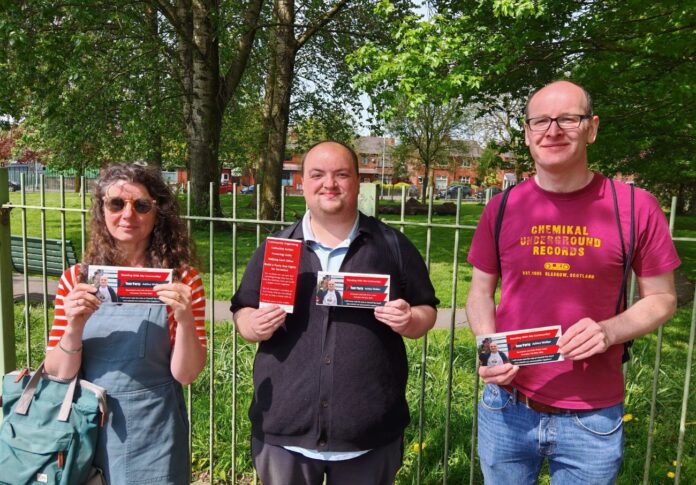
In the recent local elections, a mate of mine who is a member of Stockport Your Party (YP) proto branch was the official YP candidate in a ward where he grew up and where he still lives. Our YP branch distributed a leaflet combining local and national issues, we held street stalls and he did well at the hustings. Result? He got 54 votes. The Green Party, new to this ward, barely campaigned at all yet received 954 votes, a few less than Reform.
It was not a unique verdict. Stockport socialists have traditionally contested local elections in another ward, also a mostly white, deprived estate and never polling more than around 50 votes. Yet this time, Reform UK won this ward with 843. The TUSC candidate received a miserable 32 votes. So, I am asking myself, what’s the point of running left electoral candidates in wards where candidates are not part of a political party with a national profile and have no media profile locally either?
Your Party in the local elections
Last week the Socialist Worker newspaper investigated 50 or so YP-endorsed candidates. It revealed that those elected had typically been either sitting Labour councillors ousted by the purges or were backed by a well-established local organisation. Crucially, they stood almost exclusively in multiracial, cosmopolitan areas. Elsewhere in the UK, such candidates did as disappointingly as they did in Stockport.
At first sight, the Greens do seem to have broken through the barriers which socialist candidates still face. Journalist and commentator Owen Jones wrote recently about this, highlighting that the Greens received significant voting shares, won seats and even some councils. But again, they achieved nearly all this in multiracial and cosmopolitan urban areas with a high percentage of younger people. Only Reform attracted substantial votes in white working class-dominated areas, especially in deindustrialised areas.
Any socialist electoral strategy that does not include working to win such working-class voters to socialism is not a full strategy. We cannot do this, however, without a coherent, compelling and demonstrable narrative that enables us to engage people in honest discussion about why they are marginalised, politically, economically and culturally and how we might end it. With few exceptions, we are not doing this.
Socialists and ‘default electoralism’ – a history of cyclical disappointment
The usual justification I receive from socialists perennially fighting seats in vain is that elections are times when politics is thrust into the limelight and is on people’s minds. Yet election campaigns in this era are not about politics, but rather about what we could call ‘politicking’.
There is a crucial difference between the two. In the Westminster electoral system, politicking focuses almost exclusively on the machinations and propaganda of rival groups of professional politicians. All of them are equally committed to neoliberal capitalism; all promote themselves and their own party mostly to gain votes and chase power. What is for the public good is mostly ignored. It is personality- and scandal-focused. It is mere noise during elections and echoed in the media and hence rules out rational political debate.

Politics is NOT this. Politics is the ‘battle of ideas’ between the various factions supporting capitalism and socialism – and something that we should be waging continually. In my opinion, trying to do this during election campaigns is harder than at other times. In any case, why would we want to enter the politicking arenas of parliament, local government and TV studios, filled by hard-nosed members of the politicking class, funded to their gills, skilled in the dark arts and armed with smears and fantasies about us and what kind of society we want?
Therefore, ‘default electoralism’ turns us into self-punishing fools trying to raise socialist ideas while the maximum BS is being churned out. This is opposed to those regular occasions when people’s daily lives throw up the important issues we should be talking to them about. Take the situation in the USA. Opinion polls there have proven time after time that public support for a public health system is over 80%. Yet when the noisy theatre of national elections is in full swing, public health care seldom triumphs as an issue. BS mostly does instead. Hence, Trumpism.
Could socialists break through electoral barriers as the Greens have begun to do?
Another takeaway from these recent results is that success in local electoral activity – in Stockport or anywhere – depends a lot on national profile. Your Party, like previous and current socialist groups, simply does not have resonance in the public realm, whereas the Greens now do, especially since Zack Polanski became leader. They have an image, albeit one under attack, in the minds of voters who have an approximate idea of what they stand for.
No matter how much local campaigning we do, if we are not known to people through the media they absorb, they will vote instead for those who have some sort of profile, whether they have campaigned locally or not. This is especially true in deindustrialised areas.
Unless and until socialists achieve national resonance, either through Your Party or yet another new socialist party, the only meaningful electoral strategy for us is to campaign with the Greens.
Standing alone just means more derisory votes for socialists and perpetuates defeatism.
Subscribe to our regular updates to receive the latest articles, analysis and news direct to your inbox at https://theleftlane.media/subscribe/