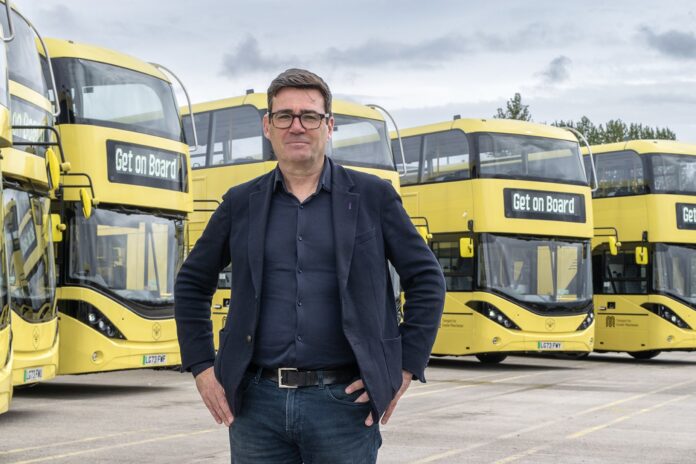
Andy Burnham is stepping up. Stepping up, on behalf of the country, to “save Labour”. Yet, as the mayor of Greater Manchester, Burnham has just presided over some of the worst Labour defeats of the May elections. 24 of 25 seats lost to Reform in Wigan, with a similar story in Salford, Tameside, Bolton and Oldham. It is hard not to conclude that if all the council seats had been up for re-election, Labour might have been wiped out in Manchester.
Burnham (along with the ‘heavy hitter’ MPs Rayner, Powell and Nandy) should surely take some responsibility for the losses in their own city. In that context, why would anyone think that Burnham can save the party? Many point to his flagship policy – the Bee Network – as having delivered a transformative improvement in public transport for Manchester’s working class.
Were the people who voted Reform too stupid to see the difference Burnham’s transport policies had made to their lives? Scratch below the surface to understand the reality of public transport in Greater Manchester and a rather different picture begins to emerge. It is a picture of uneven services favouring gentrified areas, but leaving many working-class communities isolated and of transport workers battling with private-sector employers to protect their pay and conditions.
Of course, the Bee Network is an improvement on the dysfunctional mess created by Thatcher’s deregulation and privatisation of bus services outside London, with unaffordable fares set by companies who’d cherry-pick profitable routes, few if any bus services to poorer areas and no co-ordination between multiple companies (even on the same routes). There were over 30 bus companies operating across Manchester alone. Ridiculously, season ticket holders would have to wait at the bus stop for the right company to turn up, because their pass was invalid on competing buses going to the same place!
Even the Tories eventually realised that it was necessary to bring bus services under some kind of democratic control, passing the Bus Services Act in 2017. When Burnham, as the new mayor of Manchester, set out to take advantage of this legislation and develop the Bee Network, he was no doubt in part inspired by the progress that had been made much earlier in London to rationalise and simplify public transport. However, the political groundwork in London had been laid by Ken Livingstone’s hugely popular ‘Fares Fair’ initiative in 1981, consciously seeking to make public transport affordable for all, with fares subsidised by raising higher council taxes from the better-off.
Livingstone built strong relationships with the trade unions and with community groups to counter opposition from the Tories and it is unlikely that the subsequent integration and rationalisation of services in London would have been achieved without that base of support. Would Burnham fight for that kind of egalitarian service in Manchester, or did he see the Bee Network more as a tool in the neoliberal regeneration of the city, alongside public-private partnerships, property-led development and gentrification?

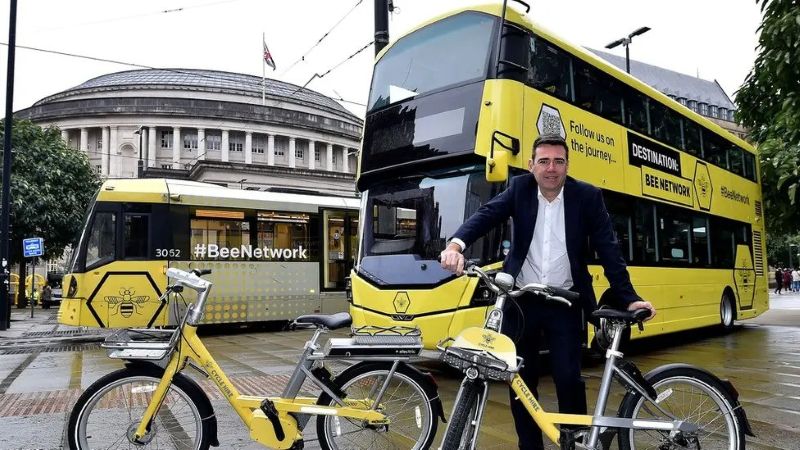
Through the Bee Network, Transport for Greater Manchester (TfGM) now franchises the operation of bus services to a number of private companies under a shared livery, with influence over the routes they operate and the fares they charge. TfGM also owns the tram network and subsidises some local rail services. However, it has taken almost ten years to get to a point where contactless payments will calculate the optimum fare across trams and buses and integration with payments for train services is not expected to complete until 2030. It is still not possible to see what time your next bus will arrive when you’re waiting at the bus stop, a service that London has had for two decades.
In the meantime, bus services across large swathes of Manchester are either infrequent and unreliable, or non-existent, with the best services operating in more affluent areas of the city. As part of classic Blairite gentrification, transport investment has been targeted at redevelopment zones like Ancoats, New Islington, MediaCity, the Oxford Road corridor and central Salford, driving up property prices and rents whilst driving out working-class communities.
Poorer areas and those more remote from the city centre still suffer from far fewer bus routes – areas in north Manchester, Wythenshawe, Little Hulton, Langley, Harpurhey and Rochdale, for instance. Most services that do exist in such increasingly isolated areas are typically radial, going only into the city centre and buses are infrequent.
When Starmer announced in 2024 that the national £2 single fare cap would go up to £3, Burnham grabbed the headlines with his unilateral declaration that Manchester would keep the £2 cap. It was noticeable, though, that Burnham didn’t take the opportunity to make the case (and campaign) for adequate funding from government to finance the services needed in Manchester, nor for bringing the franchises into public ownership and full democratic control. What better time to make that case than in the early days of a Labour government holding a majority in excess of 150 MPs? Maybe if he had, Labour might not have lost 109 councillors across Manchester in the May elections.
There were, of course, consequences to the retention of the price cap and the shift in the balance of subsidies from the Treasury to a council and its agencies already under the cosh from decades of austerity. The price of season tickets shot up, seemingly to compensate for the £2 fare – robbing Peter to pay Paul and penalising people getting the bus to work. More significantly, perhaps, the private bus companies have been under growing pressure to cut their costs.
Downward pressure on the real value of wages over a number of years culminated in a wave of hard-fought strikes by drivers at Stagecoach, Metroline and First Bus and there have been strikes by workers employed directly by TfGM. The drivers’ strikes were hamstrung by the fact that they were against multiple companies who could play the workers off against each other. Company X says to its workers: “We can’t pay you more than Company Y,” yet there is no mechanism for collective bargaining across the companies.
Whilst visiting picket lines, strikers would share stories about how the franchises were simultaneously squeezing their workers and treating passengers with contempt. Bus drivers say that they have been instructed to off-board passengers and terminate journeys mid-route when there are insufficient people on-board for the journey to be profitable – even at night. They also talk about how they have been advised by management to carry an empty bottle to enable breaks to be taken without access to toilets. This is the logic of neoliberal madness.
In one recent strike, a bus depot branch secretary said that one minute Burnham would be washing his hands of the negotiations to put pressure on the union whilst the employer refused to grant concessions. Then the next minute he seemed to have gone into behind-the-doors conversations with the employer to agree a deal when it suited him … without any transparency nor accountability. According to the branch secretary, Burnham would make glib calls for “a fair resolution” whilst insisting that TfGM was “not awash with money,” but in reality he has exploited the franchising relationship to disown responsibility for bus workers’ pay and conditions, whilst pressurising the companies to cut costs.
Like all cities, Manchester needs an integrated, affordable and easy to use public transport system that connects all communities through fast and frequent services – both for social justice and for economic productivity. This can only be achieved through public ownership and democratic accountability and with adequate central government funding. All of that requires local leaders who will take up the arguments with central government and campaign for what the city needs.
In contrast, Burnham seems to have been content to subjugate the Bee Network to his wider strategy of neoliberal municipalism – to “regenerate” the city by attracting private finance, driving up property prices and creating pockets of gentrification for the better-off, leaving large areas of working-class Manchester neglected and isolated.
Ken Livingstone’s achievements in London were grounded in an alliance with the unions and with community groups. In contrast, Burnham’s policies have by their nature put him into conflict with transport workers and with community campaigns against property developers, unaffordable housing and gentrification. These are the very forces who can mobilise against austerity and defeat Reform.
What is the point of a £2 fare, if there are few or no buses where you live, or if the journey is infeasibly slow? Increasingly, Burnham’s flagship policy may be looking like “lipstick on a pig” for many working-class voters, fed up with being conned by slick headlines and shiny new buildings delivered by politicians unwilling to stand up for their interests. Who knows how much this may have influenced the May elections across the city?
It really does not hold water to suggest that Burnham’s flagship Bee Network is municipal socialism, somehow superimposed onto his otherwise neoliberal administration. The truth is that voters in Manchester, crying out for change, deserve better, as does the rest of the country.
Subscribe to our regular updates to receive the latest articles, analysis and news direct to your inbox at https://theleftlane.media/subscribe/