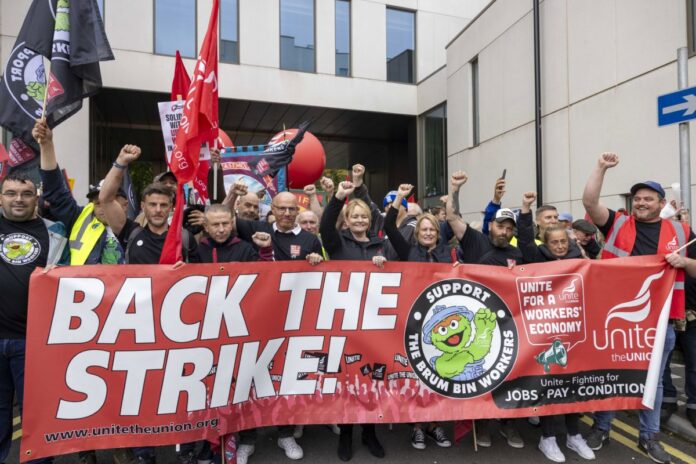
The Birmingham bin strike which has rumbled on for 17 months is still continuing after the city council said that “no deal exists”. Before May’s local elections, the then Labour leader of the council John Cotton, said that an end to the strike was in sight and that the local authority was close to settling its dispute with Unite the union after reaching an agreement.
However, a change of political control on the council following the local election results means that Labour is no longer running the local authority. In a statement from Birmingham City Council last week, officials made it clear that as Cotton’s pledge to bring the dispute to a conclusion was made in a political capacity during an election campaign, not as the leader of the council, then “no deal exists” to settle the strike.
The Birmingham bin workers’ union Unite have also recently warned that the “deal to end the bin strikes struck by the old political leadership hangs in the balance,” saying that this is partly due to officers and government-appointed commissioners being “potentially ready to pull the plug, regardless of the position of the new political leadership”.
As a reminder to readers, the plan of the previous Labour council to impose massive pay cuts of £8,000 a year, or at least 20% cuts in pay for bin workers, has been rightly resisted by an all-out strike by Birmingham Unite members who have spent 16 months on the picket line to defend their terms and conditions. They have also been supported by thousands of workers from as far away as Cornwall and Glasgow, who have stood in solidarity with the bin strikers to close depots through huge pickets encouraged by the online organising tool Strike Map. The strength of support from across the country has undoubtedly been a key factor in encouraging the workers to stand firm.
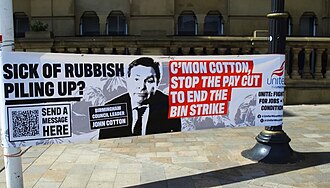
Prior to the 7 May local council elections, Unite and the Labour leaders agreed a deal which involved pay cuts phased over two to 10 years, but with guarantees on pension payments and disciplinary matters. According to sources on the ground, the deal seems to have been agreed by Unite bin workers, but there has been no ballot.
All of the political parties prior to the May elections, including Reform, were committed to a “fair deal” to resolve the dispute, but predictably none would put any numbers on it, keeping their promises vague in advance of the election result. Mirroring events across the country, both Reform and the Greens made big gains at the expense of Labour in Birmingham, however, no party reached the 51 seats needed for a majority. The new minority administration reached just 38, made up of 19 Greens, 12 Liberal Democrats and seven Better Birmingham members. No party was prepared to work with Reform.
None of the parties who became part of the new ruling coalition have said that they support the Unite deal. While the Greens are the largest group, in a deal struck within the coalition, the Liberal Democrats will hold the leadership until 2028, while the Green Party will take the leadership from 2028, should the coalition last for that long.
The next full council meeting to consider the issue will be next week, on Tuesday 14 July. Brum Rise Up, a grassroots coalition of community activists and trade unionists are calling for a mobilisation in support of the strikers at the council meeting between 12:30pm and 2pm.
Roger Harner, the new Liberal Democrat leader of the council supported by the Greens, has said in media interviews that he would not rush into a deal but rather review the matter and assess all options, ominously stating that he wanted to caution residents that “it will take a little while”.
The question at hand in the council meeting is will the Green Party, flush with left-wing credentials after the election of Zak Polanski as leader, back the deal offered by Unite, or accept more delay to a resolution of the long-running strike?
Subscribe to our regular updates to receive the latest articles, analysis and news direct to your inbox at https://theleftlane.media/subscribe/