
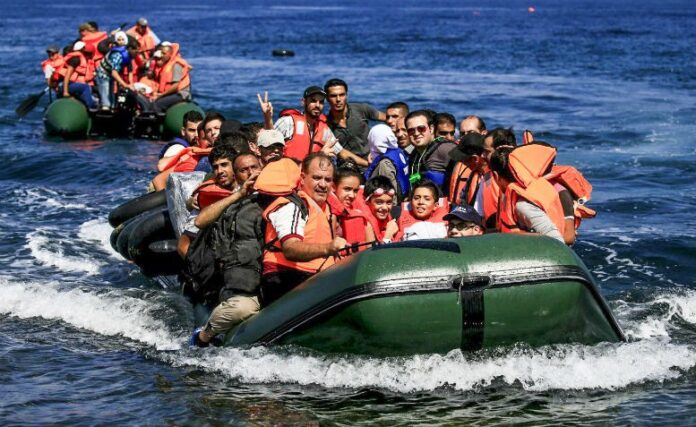
About 250,000 years ago, on the shores of Lake Tanganyika filled with omega three-rich brain building sardines, the human race emerged. There is no dispute that Africa was the cradle of humanity, but whether humans emerged as a single group or from mingled groups is not clear. Most of the controversy misses one single observation, the magical human brain rather than the fossil record, why the fat profile of the human brain mirrors that of the freshwater sardines found in this giant lake.
We are all Africans by origin. We are all therefore migrants who learnt to or were forced to walk every continent on this planet, the only species to do so. During the course of our generational wanderings up and down the planet, we adapted to the tilt of our planet, skin colour, hair and certain facial features changed. But we remain one big family torn apart by national capitalist classes serving their own narrow propertied interests and who violently claim this planet as their own.
Today the biggest single political issue is renewed migration. No person voluntarily leaves their relatives, their communities, their home for an uncertain future, unless the present is even more uncertain. And only one condition makes for that level of uncertainty – acute economic insecurity and stressors.
And the world is becoming increasingly insecure especially in the poorer capitalist countries. Imperialism has invaded, isolated and actively undermined economic development in many countries to maintain a state of dependency. Added to this are the ravages of climate change, the very conditions that led to the ‘out of Africa’ mass migrations tens of thousands of years ago.
Decades of rising inequality and austerity has created zero tolerance for migration
Capitalism has always had to manage economic migration. While employers would welcome mass migration, they do not welcome the political instability it brings. The degree of instability in the imperialist economies depends on the financial circumstances of the mass of society. Decades of rising inequality, tax dodging, cool investment but hot speculation, precarious employment, austerity and a cost-of-living crisis, has created zero tolerance for migration.
This has allowed the far right to exploit migration as the key source of the problems facing workers both economically and culturally. This has allowed parties like Reform to deflect anger sideways against migrants and foreigners. A single orientation distinguishes the right from the left. Whereas the right deflect anger sideways and away from the rich and the powerful, the left directs anger upwards toward those who rule, oppress and exploit us, and who created the conditions forcing workers to search out increasingly scarce jobs. And that was before AI.
So, what should socialists’ position on migration be? While we don’t oppose migration under the banner of freedom of movement, we don’t advocate for it either. A simple analogy will suffice. While we support the right to divorce, we don’t advocate that all couples should get divorced.
Instead, we, like the Journal of Family Psychology, recognise that financial stress and arguments around it are the single biggest predictor of divorce. Thus, the same apologists for capitalism who oppose divorce are the same ones promoting the conditions which make divorce more likely. The same thing applies to migration. Those who oppose migration are the same apologists for capitalism who obscure the causes behind migration.
Let us turn to a less controversial issue. We don’t advocate that workers jump from one company to another in search of a better employer. Rather we encourage them to remain and unionise their firm to get their bad employer under control. Jumping from company to company is an ineffective individual solution, whereas staying put and unionising it is a collective act which ends up building a union movement.
Similarly, we recognise that economic migration is an individual choice, whereas remaining at home to organise for political change in one’s own country is a consequential political choice. This is not a novel argument. Inspired by the Russian Revolution, many national liberation movements sprang up in the interwar years in Latin America, Asia and Africa. Many communist parties in the imperialist countries assisted their rise.
A programme of demands to help us fight back
Thus, our focus should not be on migration as much as it should be on the causes of migration, not only in words but in solidarity. This requires we fight for the following demands.
- An international investment bank to invest in the poorer regions. Unconditional financial assistance where needed not IMF punishment.
- Tax the rich to fund this bank and provide a safety net.
- No tariffs on imports from these countries.
- Cancel all outstanding debts.
- Troops out–no military or policing role for imperialism, especially US imperialism.
- Abolish the UN Security Council and vest all power into the General Assembly.
These and other transitional measures will allow us to counter the argument of the racists that that we are simply the champions of migration.
Subscribe to our regular updates to receive the latest articles, analysis and news direct to your inbox at https://theleftlane.media/subscribe/