Two years ago, the choice at the ballot box was not Labour’s Andy Burnham versus Reform’s Robert Kenyon. Rather, it was Keir Starmer and his Labour cohort versus Rishi Sunak and his Tory mates.
As that 2024 general election approached, political philosopher Lorna Finlayson assessed the choice facing voters in an insightful essay titled, On Lesser Evilism.
As we will see in a moment, the concept also has resonance in what has been called “the most consequential byelection in British history,” an assessment made by mainstream media commentators who have an extremely limited understanding of what is and what is not consequential. Just because Burnham called his victory “a turning point for the country” and Wigan MP and cabinet minister Lisa Nandy labelled it “historic” does not make it so.
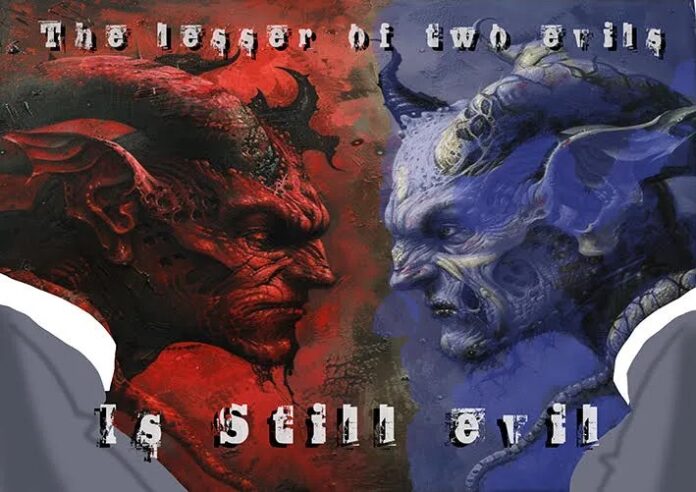
To choose the lesser evil is to pick what appears to be the better of two bad options. To do otherwise might seem “illogical,” Finlayson wrote. But she argued, persuasively in my view, that progressives and socialists should stop treating this as the gold standard by which political decisions are made – including at the ballot box.
With a programme based on “petty authoritarianism, ‘fiscal discipline’ and fealty to the White House,” Starmer was hardly inspiring confidence as the 2024 election neared, Finlayson wrote in her January-February 2024 piece for New Left Review (behind a paywall but well worth trying to get a copy).
Put aside your qualms
So, the Starmerite commentariat at The Guardian and New Statesman set to work in the spring of 2024. They went about urging the unconvinced “to put aside their qualms and a vote for the lesser of available evils,” namely Starmer over Sunak and his widely discredited Tories after their 14 long, exceptionally long, years in power.
The day after Makerfield, Finlayson’s warning about the dangers of the lesser evilism approach, as well as of Starmer and Labour, looks quite prophetic… and in spades.
The “change” Starmer and Labour promised in 2024 – presumably progressive change as “change” itself is a woolly word – did not arrive. Instead, his government has resorted to desperate gestures such as banning under-16s from social media. Voters had been sold a rancid bag of false hopes.
Burnham as a double lesser evil figure
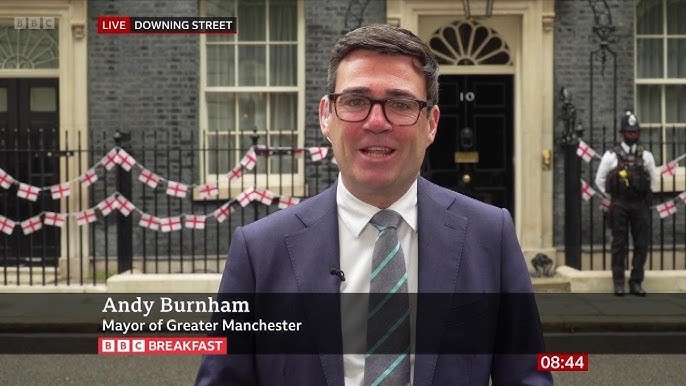
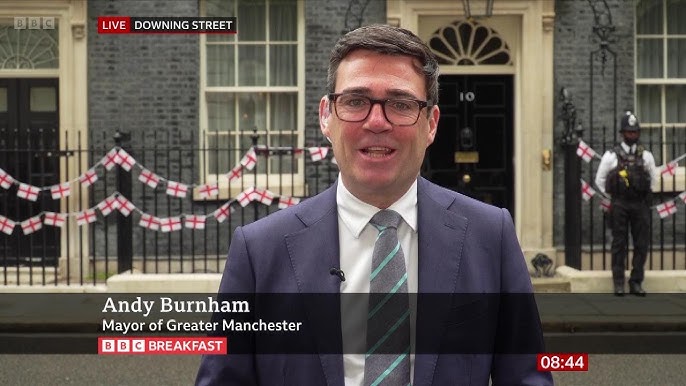
Have we just been sold more rancidity? The dangers of this lesser-evil approach are likely to become clear in the days following Andy Burnham’s victory in the Makerfield byelection on Thursday. Indeed, for many people, including many on the left, Burnham acted a as double lesser-evil figure.
Burnham became “both the anti-Farage and anti-Starmer candidate all in one,” as the Morning Star put it in its 12 June editorial. Although the editorial noted a number of weaknesses in Burnham’s politics, it concluded, “The (Morning) Star unequivocally advocates a vote for Andy Burnham, the Labour candidate”. The phrase “Burnham is the lesser evil” was not used. But it very easily could have been.
Over at The Guardian, columnist Polly Toynbee is always focused on Labour’s best interests as she sees them. Her column from Manchester on the same day was tagged “Everyone here knows but this is a sliding-door moment. A win could be a new beginning for the party, a loss and unimaginable calamity”. Panic stricken, Toynbee asked: “Would the party survive?” if Burnham loses. In other words, anything to ditch Starmer, someone she once talked up a lot.
Meanwhile, here at The Left Lane, we published an opinion piece a few weeks ago from a Green Party member that was critical of Burnham but said his party had made a “poor” decision to field a candidate in this byelection. (Tangentially, some in Your Party wonder why it did not field a candidate. Embarrassingly, newly formed Restore Britain ran a candidate who won 7% of the vote for a third-place ribbon and gained some national media profile. And trust me – because I live in Norfolk, less than 20 miles from Restore’s home base of Great Yarmouth – this rag-bag far-right outfit has far fewer members than the 50,000 members claimed for Your Party by its unofficial CEO Karie Murphy.
Lesser evilism by default
Back to the Greens. Andrew Hedges wrote in The Left Lane: “Many progressives will see Burnham as the only plausible way to stop Farage and if the Greens are perceived to get in the way of that, it will pose a big problem for them in broadening their appeal”. In any event and despite their recent triumph in another Manchester by-election, the Greens took their foot off the electoral pedal here and won a mere 0.7% of the vote as its new electoral mastermind, Miles Thorpe, took a holiday. Call it lesser evilism by default.
In a brief news commentary written on deadline, there is not the space or time here to fully reproduce and explain Finlayson’s whole argument and its various strands. Nor does this article rehearse the reasons why Burnham is no radical, preaches neoliberalism (despite his words to the contrary) or why his call for “pro-business socialism” makes as much sense as a call for “anti-business capitalism”. Instead, read Anita Patel’s class analysis of the Manchester Bee Network in The Left Lane or Hilary Williamson’s Novara Media piece How Left Wing Is Andy Burnam?In brief though, here are four reasons why “lesser evilism” has failed us as a way of approaching the important issues arising from Andy Burnham’s byelection victory, a hurdle cleared perhaps on his way to 10 Downing Street.
- We need to learn the lessons from the failure of the 2024 version of the lesser evil, namely Sir Keir Starmer.
2. Look at the main failing of the lesser evilism approach when it comes to elections. Finlayson writes: “Perhaps the most obvious response is to point out the way it directs our attention onto a question that matters much less than others we might ask. Why are we debating whether or not to vote for A, who is (let us suppose) marginally less odious than B, rather than thinking about how we came to be faced with such an appalling choice in the first place? Because, it is tempting to answer, diverting the public with this relatively inconsequential question is rather useful to those with power. As long as we’re busy debating A versus B, we will feel like we’re involved in political decision-making, but without being in danger of actually changing anything. And if A versus B is so boring that many people lose interest in ‘politics’ altogether, so much the better.” Right on Lorna!
3. To members of the Labour Party, perhaps Burnham may be less odious than Starmer. And the ‘King of the North’ may indeed become PM after a possible coronation and Labour’s poll numbers may rise. But should “saving Labour” be a preoccupation of socialists? Can the Labour Party be radically changed? More and more of us say “No”. Its main role is managing capitalism and Burnham’s record as a Labour mayor of Greater Manchester was no different. Moreover, the idea that 18 June 2026 is a “turning point for the country” is frankly laughable.
4. Of course, Burnham was less odious, less evil a candidate in Makerfield than Reform’s Rob Kenyon, a sexist and male chauvinist to the core. But Burnham has shown no understanding of Labour’s own role in the rise of Reform. For example, he said during the byelection he fully backed the current government’s repressive campaign against refugees and asylum seekers. See Williamson’s piece above. In his new book on the rise of the far right, writer Daniel Trilling explains how the establishment, which obviously includes the Labour party, has facilitated the rise of Reform, Restore, Robinson and the rest. See a review of Trilling’s book and its details here. (Note to readers: Daniel will be our guest at The Left Lane’s first public webinar on 9 July. Watch this space for details).
Burnham said last night his victory could be “the final chance for change” to politics in the UK. Yes, perhaps your final chance to be PM, Andy, but some of us have greater aspirations about how politics needs to be transformed, in fact revolutionised – and that goes far beyond having the seventh occupant of Downing Street since 2015.
Subscribe to our regular updates to receive the latest articles, analysis and news direct to your inbox at https://theleftlane.media/subscribe/