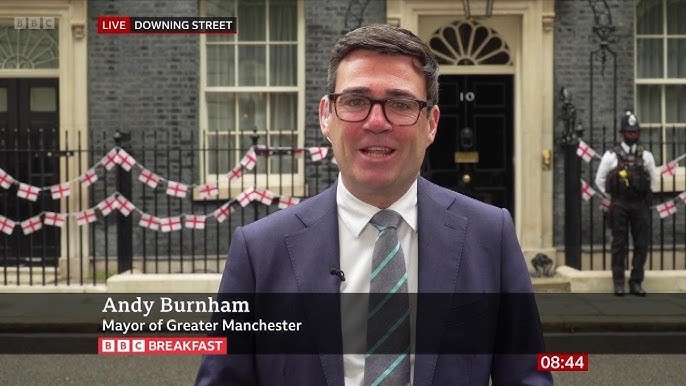
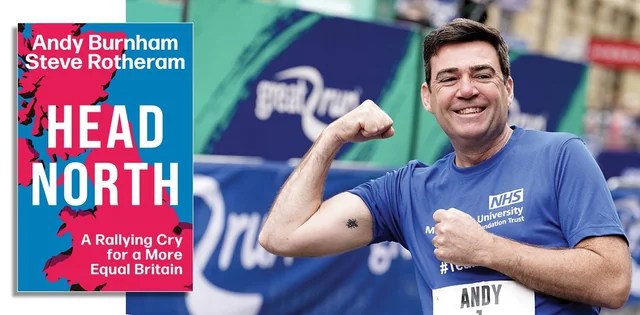
Andy Burnham’s victory in the Makerfield by-election and his expected tilt at Keir Starmer’s leadership, has been greeted in some quarters as the arrival of a transformational figure – the ‘King of the North’ finally storming the gates of Westminster to remake British politics. Before anyone gets carried away, it’s worth going back to the book Burnham co-wrote two years ago with his close ally Steve Rotheram, the Liverpool City Region mayor, to see what kind of prime minister he might actually be.
Head North, published in 2024, was part memoir, part manifesto. I reviewed it at the time on the Labour Hub website and rereading that review now, in light of last night’s result, it reads less like an exciting blueprint and more like a useful corrective to all the hype around Greater Manchester’s soon-to-be former mayor.
The book’s case is built on a real and recognisable grievance – that Westminster is a closed system designed to entrench the power of those who already hold it. As Burnham and Rotheram put it, the parliamentary system “remains the same – a system built to concentrate power in the hands of the already-powerful,” and that concentration is, in their telling, the root cause of Britain’s economic imbalance. They trace their own anger back to Hillsborough and draw a line from that injustice through Grenfell and the Post Office scandal to a wider argument about who Westminster works for.
It’s a compelling story and an authentically northern, working-class one. But the actual prescription on offer – the ten-point Head North Manifesto – is far more cautious than the rhetoric around it suggests. Scrapping the House of Lords, a written constitution, voting reform, a senate of the nations and regions, full devolution, ending the parliamentary whip – these are structural, institutional reforms. Worthy enough, but they are reforms to the architecture of power, not to who holds economic power in this country.
There is nothing here about ownership, about redistributing wealth, about confronting capital. The manifesto’s most eye-catching pledge – “Net Zero to Reindustrialise the North” – is itself a fairly safe synthesis of two ideas that have been government and opposition orthodoxy for years.
This matters now because the question facing anyone watching Burnham’s expected leadership challenge isn’t whether he can talk convincingly about northern alienation – he plainly can, better than almost anyone currently around in British politics, though that is admittedly a very low bar. The question is whether a Burnham premiership would change who has power and wealth in this country or simply rearrange where decisions are made while leaving the underlying settlement intact.
Head North gives a fairly clear answer. Burnham and Rotheram are explicit that their project is gradualist. They describe wanting to “build a movement of people over the next 25 years which will eventually change Westminster from the outside”. That is not the language of someone planning a rupture with the status quo from Downing Street. It is the language of a long, patient, devolutionary project – one that, by its own timeline, was never meant to deliver its results inside a single Labour government, let alone inside the opening months of one.

There’s also the question of where Burnham actually sits politically. He was a minister under Tony Blair and nothing in Head North suggests a break with that New Labour inheritance so much as a regional, devolutionary gloss on it. The book’s anger is real, but it is channelled into process – constitutions, senates and voting systems – rather than into the kind of redistributive economic programme that would actually shift the balance of power between labour and capital, or between ordinary people and the wealth that has accumulated in the south east over the past four decades.
None of this is to say a Burnham government would be indistinguishable from a Starmer one. His authenticity and his ability to connect with people who feel Westminster has abandoned them are genuine political assets and ones Starmer has conspicuously lacked. Burnham’s popularity, in a country described by reporters covering Makerfield as exhausted and “absolutely a mess,” is itself evidence that something in his pitch is landing. But popularity and authenticity are not the same as a transformational programme.
If Burnham does become prime minister, Head North suggests we should expect a government preoccupied with devolution, regional rebalancing and constitutional tinkering – a genuine, sincerely-felt project, but one aimed at where power sits rather than how it is distributed. For those of us looking for a government that confronts capital rather than rearranges the committee structure around it, Burnham’s own book is the best guide we have to the limits of what’s coming. The header says Head North. The substance, on this evidence, points somewhere closer to the centre.
Head North: A Rallying Cry for a More Equal Britain, by Andy Burnham and Steve Rotheram, is published by Trapeze, price £10.99.
Subscribe to our regular updates to receive the latest articles, analysis and news direct to your inbox at https://theleftlane.media/subscribe/