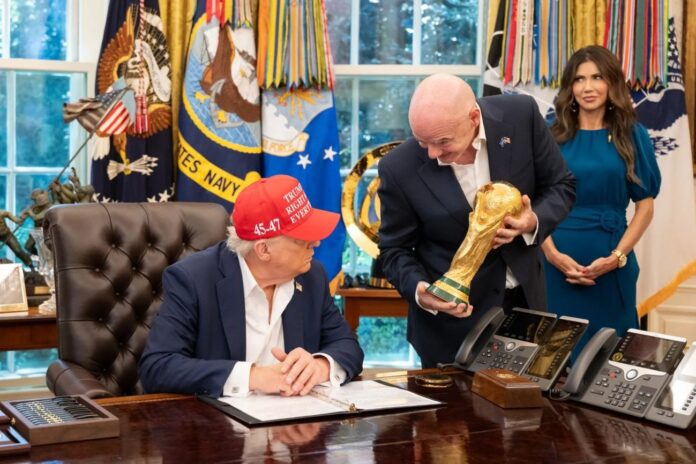
Despite the controversial inclusion of star striker Folarin Balogun in their starting line-up, the US men’s football team were well beaten by Belgium on the pitch last night – and by President Trump off it.
The president, who until recently did not know what a red card was, turned football expert by intervening into the world of football with what appears to have been disastrous effect for the US team.
With one call to Gianni Infantino, the FIFA president who invented a FIFA Peace Prize to give to Trump months before he launched a murderous and illegal attack on Iran, Trump got FIFA to change its mind and allow Balogun to play, through the use of a rule that almost no one had ever heard of. Uproar and outrage followed, with even European football’s governing body UEFA intervening to say that the decision had “crossed a red line”.
World football has long been tainted by political interference, most shockingly by the England men’s team being ordered to give the Nazi salute in Berlin’s Olympiastadion in a friendly in May 1938.While the Balogun incident is light years away from that shame, the stench of politics, money and corruption has been ever-present in the 21st-century world of football.
Many felt uncomfortable with the 2018 World Cup finals being staged in Russia following the forced annexation of Crimea and this unease grew as the implications of the awarding of the 2022 finals to Qatar became clear. FIFA claimed the award had absolutely nothing to do with the oil wealth on which that country sits while others claimed kickbacks and corruption and the deaths of over 7,000 migrant workers, many of them in construction, in the decade prior to kick off, marred the whole event.
The US finals were always going to be a tricky affair. The US banned a Somali referee Omar Artan, because he was a Somali and hounded the Iranian team through the use of visa regulations, all in contravention with FIFA’s professed claim that the games are not to be interfered with by politicians.
Many suspected the mandatory three-minute mid-half hydration breaks at each match, irrespective of the heat conditions, were introduced to make space for US advertisers to get their pound of commercial flesh. Then the Balogun red card was suspended, with Trump appearing delighted at the results of his intervention.
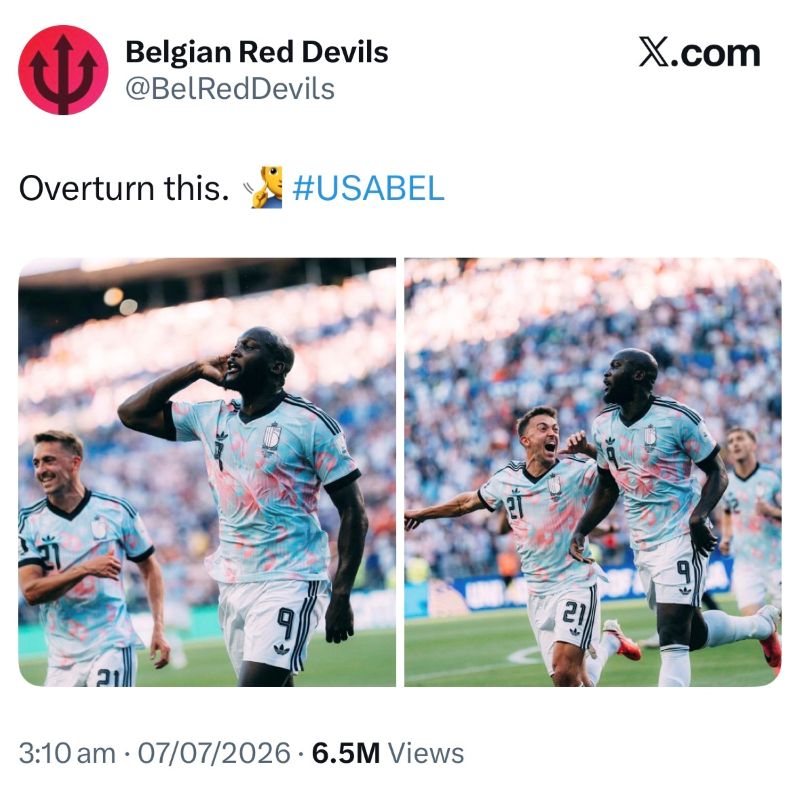
In the end, the United States team were well beaten. Folarin Balogun was almost entirely ineffective in attack as part of a front line that had few shots on target, with the goal being a deflected free kick. Despite having the home crowd with them, the US were played off the park by a Belgium team who had had a poor start in their group stages but were dynamic and clinical throughout the game, even without star players De Bruyne and Doku on the pitch.
The final nail in the US’s World Cup coffin was delivered by a serious error by the US goalkeeper, Matt Freese, who capped off a disastrous performance by the US defence. Dealing with a clearance, he kicked the turf and lost the ball, allowing Belgium’s Hans Vanaken to pass the ball into the net from outside the area. Veteran Lukaku completed the misery with the fourth.
It seemed the US team’s minds were not entirely on the pitch. Balogun underperformed along with the whole team, who never really played to their potential.
It is difficult to understate the key role that psychology plays in some football games. One moment a team can be flat on its back and a twist of fate on the pitch can turn events and confidence in a different direction. On this occasion it seemed the US team was playing under a cloud of Trump’s making and US football and its fans paid the price. The big question is whether FIFA president Gianni Infantino will also have to count the cost of his fawning to Trump.
Subscribe to our regular updates to receive the latest articles, analysis and news direct to your inbox at https://theleftlane.media/subscribe/