With 211 national associations FIFA claims more members than the International Olympic Committee’s 206 or the 193 of the United Nations. FIFA likes to project itself as something more than a sporting governing body. The last three presidents of FIFA, João Havelange, Sepp Blatter and Gianni Infantino, have each sought to expand FIFA’s global political and financial influence.
The expansion of this year’s World Cup to 48 competing nations and a target of $11bn in revenues is a continuation of that strategy. FIFA claims that five billion people, some 62% of the world’s population tuned in to the 2022 World Cup. There is a clear calculation that this year’s expanded tournament will see that audience grow. In FIFA terms, a bigger audience means more cash and more power.
It has been over ten years since charges of corruption led to the arrest of FIFA executives and the removal of Sepp Blatter as FIFA president. Under Gianni Infantino, Blatter’s successor, the accusations of corruption remain and the cosying up to despots and the enablement of sportswashing has continued apace. All the while fans of the game look on in horror, becoming increasingly disillusioned with the growing commercialisation of the modern game.
A sport popularised and played extensively by workers and codified by middle managers is now being exploited and sullied by the opportunistic grifters of the capitalist class.
FIFA – a long history of scandal
In Red Card: The 2026 World Cup, Sportswashing and the FIFA Greed Machine, academic and former professional footballer Jules Boykoff catalogues FIFA’s long history of scandal creating a readable whistle-stop history tour. Boykoff documents how the expropriation of the game by multinationals and despotic regimes has developed at pace, facilitated by venal administrators luxuriating in eye-watering salaries and perks.
As to be expected from a writer with an academic background, the 138 pages of Boykoff’s latest book is well-researched and packed full of quotes and references to earlier works on the subject. The book joins up the ‘corruption’ dots of political exploitation, personal promotion, corporate profiteering and the modern phenomenon of sportswashing.
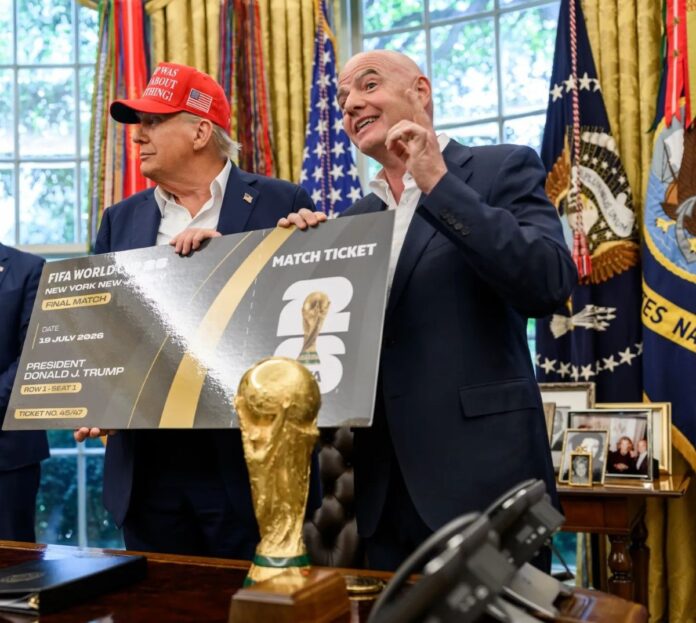
To bring the corruption reportage bang up to date and to catch the football moment of this summer, the book centres on the World Cup being jointly hosted by the USA, Canada and Mexico. Having previously written widely about the Olympics and the IOC, Boykoff has a track record in the field of mega sporting events and highlights how Trump is openly using the biggest of the world’s sporting spectacles to leverage personal and political advantage. The ‘leader of the free world’ is willingly assisted in this capacity by FIFA and Infantino who Boykoff refers to as a “grifting quisling and Trump’s human colonoscopy volunteer”.
The first World Cup was held in Uruguay in 1930 as FIFA was just finding its feet and the book details the opportunists, controversies and exploitative agencies that have pock-marked the tournament ever since. Even if you have followed the development of the game closely you will find new anecdotes or tales that they may have been long forgotten.
Using football as a cover for fascists and dictators
At the second World Cup held in Italy in 1934, the tournament was used by Mussolini to burnish his personal profile and advance his fascistic programme. A model closely followed a couple of years later, when Hitler placed himself front and centre at the 1936 Olympics in Berlin, which Boykoff contends began to establish “the key elements of sportswashing”.
Some 30 years later in the run up to the 1978 World Cup in Argentina, the military junta slowed down its torture, and ‘disappearance’ of tens of thousands of left activists and opponents of the regime to allow the World Cup to go ahead. FIFA and most of the world turned a blind eye to the horrific oppressive backdrop and ignored the widely acknowledged fact that Argentina’s military regime had the “worst human rights record on earth”.
The US government was of course an enthusiastic supporter of the junta and the “human-rights ogre” Henry Kissinger was a guest of Argentine president General Videla. The book explains how, prior to a key fixture, Kissinger accompanied Videla to the dressing room of the Peru team preparing for a crucial match against the hosts to let them know what was expected of them. Argentina won the match 6-0 and Peru’s players were accused of deliberately throwing the game. After his trip Kissinger praised the junta, saying “The World Cup has projected an excellent image of Argentina toward the world,” thus confirming that the sportswashing had worked.
Joao Havelange was FIFA president during the 1978 World Cup and Boykoff reports how FIFA’s longest serving president used his time to ensure that the system worked for him and his associates. It was on Havelange’s watch that FIFA established itself as a “corporatised money machine, grounded in grift and greed” with sportswashing as key.
Boykoff explains how Putin used Russia’s hosting of the 2018 World Cup to improve his personal profile and present himself as the benefactor of the nation with Infantino cheering him on.
World Cups of the modern era have required host nations to engage in huge building programmes of new stadia and extensions of domestic infrastructure to support the numbers of traveling football spectators. Dressed as an opportunity to “leave a lasting legacy for future generations,” the costs are borne by the host nation and the construction workers working for low pay in life-threatening conditions whilst FIFA hoovers up the revenue from commercial partners and ticket sales.
Over 400 workers were killed working on preparations for the 2022 event in Qatar with many hundreds more injured and directly harmed. FIFA’s executives point blank refused to offer any compensation even when its own subcommittee on human rights and social responsibility determined that the governing body was responsible for providing financial remedy to workers.
The first World Cup where a host has declared war on a participant
The 2026 World Cup will be the first to be hosted by three nations and staged across 12 different cities. Yet, despite the number of dodgy characters, military dictators and egomaniacs that have been in power during past world cups, the 2026 version will be the first where a host has declared war on a participant and is issuing blanket travel bans based on a supporter’s nationality.
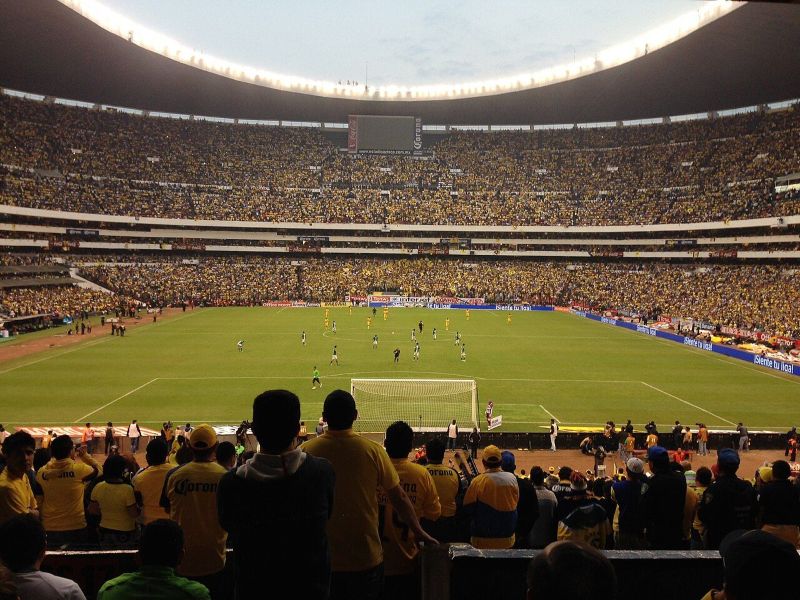
With host cities spread across a large geographical area, tickets and travel costs for supporters will easily be the highest on record. As a consequence, it is likely that many games could be played in front of rows of empty seats. FIFA is aiming to break revenue records with commercial sponsorship deals and the introduction of ‘dynamic pricing’ for match tickets.
There has been push back from elected mayors and political representatives in a number of host cities who are citing unfair contractual obligations to facilitate matches without receiving a fair share of the riches being raked in by FIFA bosses. FIFA is standing firm and it will be supporters that are expected to pick up any costs defrayed by the host cities via increases in transport and accommodation costs.
The ceiling for sportswashing and commercialism is unlikely to be met any time soon as Saudi Arabia has already been nominated as the host for World Cup 2034. Having seen the efficacy of football sportswashing on the international level, nation states are using the power of football to wash reputations and buy leverage via soft power by acquiring individual clubs either directly or via proxies.
Boykoff refers to numerous leftists who have talked of the political importance of football with advocates avowing the game’s ability to unite all classes of society. It should therefore be no surprise that populists and dictators have also identified the cover that can be given by football to political projects and the personal gains that can be made for themselves and their associates.
Boykoff draws his commentary to a conclusion with a message of hope from Victor Quintero, an activist in Los Angeles: “It’s up to working-class people to revive the spirit of what football is.” Quintero cites the international appeal of football as an opportunity to build the resistance by highlighting the contradictions and tyranny of capitalism.
If you care about football, choose football. Pick a side. You could do worse than reading Boykoff’s Red Card as an excellent beginner’s guide to FIFA’s corrupt practices.
Red Card: The 2026 World Cup, Sportswashing and the FIFA Greed Machine is published by OR Books, price £14 for the paperback. OR Books is a New York City-based independent publishing house and the company business model promotes the sale of digital and print-on-demand books directly to the customer, promising “no-bullshit non-dogmatic leftism”.
Subscribe to our regular updates to receive the latest articles, analysis and news direct to your inbox at https://theleftlane.media/subscribe/