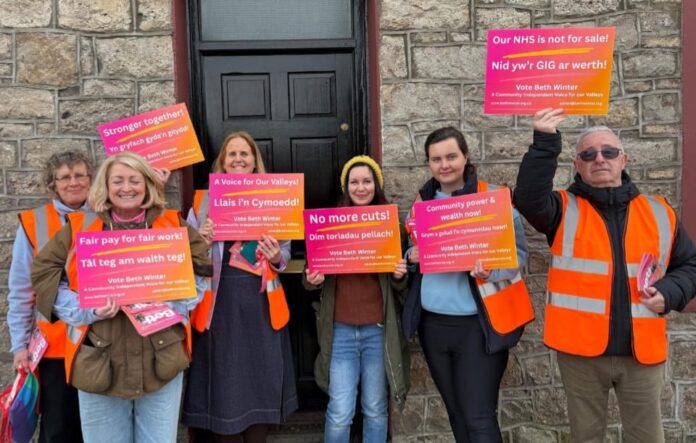
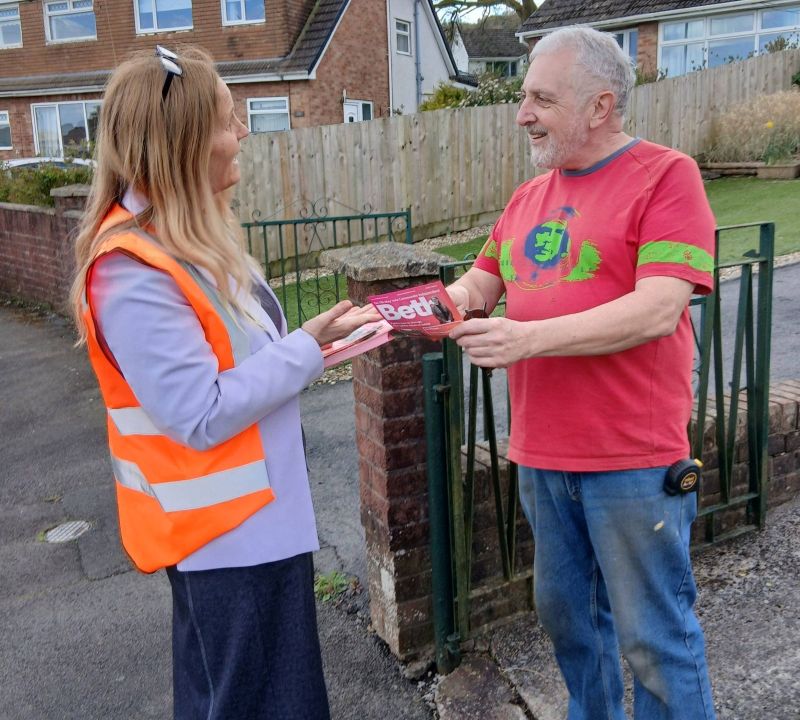
“I find it really upsetting actually,” says Beth Winter, a community independent candidate for Pontypridd Cynon Merthyr in the upcoming Welsh local elections, reflecting on one of her experiences knocking doors in the Gurnos, a housing estate in Merthyr Tydfil, South Wales. “It’s not just that people are voting Reform. So many more are just not voting at all,” Winter says. “I was speaking to one chap about it, and how politicians have lost their trust completely. This is what we’ve come to and we’ve got so much work to do. I’ll be going back to talk to him again, see if I can persuade him otherwise,” she said.
Of all the Senedd candidates, Beth Winter understands this disillusionment more than most. She herself has spoken of her own disenchantment with the political establishment after chastening experiences at the hands of the Labour Party, when serving as their MP for Cynon Valley in Westminster. A relatively late arrival into the party fold, she will admit that she found the culture and party machine difficult to fathom and you can sense the palpable relief and enjoyment in being free to campaign, unencumbered by Starmer’s lame duck Labour.
Indeed, those numerous people who have flocked to campaign on her behalf are happy to declare that the Labour Party is in fact dead in the water. What Beth Winter is about, they will tell you, is building a new politics – grassroots, embodied in a local candidate fiercely proud of her community and its people, engaged with individuals from all walks of life (you just have to listen to her endorsements) and focusing on the basic issues that affect people’s everyday lives. Anti-establishment in the true sense of the term.
“I’ve always believed in working with people, not speaking over them. That’s how I worked as an MP, keeping to my principles and opposing cuts wherever they come from – Westminster, Cardiff Bay or the local council – and celebrating all that’s wonderful about our Valleys,” Winter says. Unlike the cynicism of some politicians, and their instrumental view of voters that means hassling them once every five years for a vote, Winter’s enthusiasm for people is striking – a politician who is genuinely at home on the doorstep, or in a local campaign group, or on the picket line.
As an independent she truly stands out
In an election run on a new proportional representation system – where electors give their votes to parties and where they and not the candidates are the main characters – as an independent she truly stands out. Plaid and Reform make much of it being a two-horse race, with the former subsequently channeling the anti-Reform vote and running a campaign that is sometimes in danger of subsiding into the ‘ming vase’ approach. The latter have been busily trying to Welshwash themselves with a new leader hailed as the prodigal son from Blackwood, but his status as the former, controversial Tory leader of Barnet council and an ambiguity surrounding his residence, typifies rather how their politics and promises ring hollow.
Welsh Labour and the Tories’ main significance in the campaign is their new, crushing insignificance and the latter’s possible disappearance is only overlooked because of the collapse of what has sometimes been hailed as the world’s most successful electoral machine. The obituaries are already being written and what this all implies for their comrades in Westminster is already being speculated upon. The Greens are of course ebullient and riding the Polanski wave, positioning themselves as Kingmakers, but it remains to be seen whether the strictures of the D’Hondt system will allow them to properly capitalise on the rise in the polls.
In amongst this typical jockeying for position, Beth Winter is forthright in her simple, straightforward appeal. “Politics has to change. People deserve honesty and representatives rooted in their communities, because it is who we drive change for the better, not parties,” she says. “As an independent, I am not beholden to any party machine, their overly careful soundbites, or their corporate funders. I’m free to fight for a Wales that puts people before profit,” says Winter.
Her stated priorities reflect this spirit, advocating honesty and accessibility, a politics for the people, building a community movement and rejecting partisanship, and crucially – in a system where it is parties and not candidates who are voted for – accountability. In particular, in an election where the insurgents Reform are claiming their own anti-establishment, authentic credentials, Winter’s record and ties to the community, where she was brought up and lives with her family, are in sharp contrast with long lists of faceless candidates without any backstory, or more high profile former Tories being parachuted in from other valleys communities, or as far afield as London (or is it Bath?).
Inspired by the history of local communities
Her key pledges are straightforward and echo with the same community-focused ethic. “I will fight for sustainable investment and empowering our people and our groups to take control of what’s theirs, seeking every opportunity to ensure that the wealth we create stays in our valleys,” she says. In this regard she is inspired by the history of these communities, the foundations they built for themselves and stories such as that of the Tower Colliery that demonstrated the possibilities of cooperativism. She is also staunchly anti-cuts and believes her status as independent will help “in being a voice speaking up fearlessly, fighting for our local services and defending them against any further attempts to take away our resources”.
Lastly, she has committed on a personal level that if elected, she will take only the equivalent of her former employment as a Union representative and using the remainder to invest in community projects, education and training – a promise therefore to lead by example.vCan she be elected, especially in a system so focused on parties? It is widely accepted that the D’Hondt system is one of the least representative possible and that to snatch that sixth seat in the new super-sized super-constituencies an average of 12% of the vote is required.
“Well, I’m not going to die wondering,” she replies. “There’s a lot said about the complexity of this new system and I have a lot of issues with it, but ultimately it is a version of proportional representation where tactical voting, in all but the most clearcut of circumstances, is fraught in the extreme,” says Winter. “In practice this means people can vote with their heart, with the assurance that there’s a much better chance than before that it will count. If I get a decent share of the votes I had as an MP, I’ll stand a chance and that was in a constituency significantly less than this one. Whatever the outcome, I’m just happy to be able offer the voters a new form of politics that I know speaks to the concerns of many,” she says.
In terms of the conversations she has had, she can at least be confident that her message is resonating with a wide array of people. “I’ve even persuaded a fan of Margaret Thatcher’s to vote for me,” she says with a glint in her eye. And beyond the slight irony, this is a story that speaks to the appeal of a community-focused politics that can cut across typical ideological divides. Who knows, perhaps that chap in the Gurnos housing estate may yet be persuaded.