The United States has always supported Israel from the 1960s onwards, former US secretary of state Alexander Haig famously characterising the Zionist state as the US’s unsinkable aircraft carrier in the Middle East. Notwithstanding such support, the US has always exercised relative autonomy in its foreign policy in the area.
It is arguable however that this independent exercise of imperial power has gradually been eroded so that US foreign policy, particularly in Trump’s second term, has been the subject of state capture by Israel. This has been achieved with the help of Israel’s US proxies, in the form of the so-called Israel lobby, not least with respect to the conflict in Iran.
As long ago as 2007, in their seminal tract The Israel Lobby and US foreign policy, professors John Mearscheimer and Stephen Walt characterised the Israel lobby as “a loose coalition of individuals and organisations who actively work to steer US foreign policy in a pro-Israel direction.”
This is pretty indisputable as a political reality, whether measured in terms of the activities of say the American Israeli Public Affairs Committee (AIPAC) or individuals such as the conservative US senator Lindsay Graham. A more tangible example because of her sheer financial clout is billionaire Miriam Adelson who donated $100m to Trump’s 2024 election campaign.
Addressing the Israeli parliament last October, Trump, speaking about Miriam Adelson in his typical ‘saying the quiet part out loud’ style, said: “I actually asked her once, I said: ‘So, Miriam, I know you love Israel. What do you love more, the United States or Israel?’ She refused to answer. That means, that might mean, Israel, I must say.”
The ‘Greater Israel’ project
Common sense dictates that funding at this level is only elicited on the basis of political alignment with Adelson’s clear agenda to advance the interests of Israel – a notable part of which is the ‘Greater Israel’ project, the Israeli intent to enlarge Israeli territory to encompass large parts of the states surrounding it. This is the stated aim of Benjamin Netanyahu and the ultra-nationalists of his cabinet. We know this because Netanyahu himself stood in front of the UN general assembly in September 2023 with a map and marked out the area of the proposed enlargement with a red marker pen.
Iran is a problem for the project because it stands in the way of Israeli dominance of the area, A good explanation of this Israeli ambition and how Iran is seen as an obstacle can be found in an excellent recent article by Samer Jabal on the Al Jazeera website.
It is a matter of historical fact that successive presidents, whilst acceding to and supporting Israel’s wishes, have always avoided hostilities with Iran since the 1979 revolution. In part this was because numerous policy analysts had pointed to precisely the outcome we have seen in the current conflict, namely Iran’s ability to choke off the Strait of Hormuz. In a recent article, the journalist Caitlin Johnson has listed the various policy papers on this point.
This consideration aside, it is all the more surprising that the US joined Israel in attacking Iran given that in an 18 March 2026 congressional testimony, Tulsi Gabbard US director of national intelligence and CIA director John Ratcliffe, both assessed that Iran posed no nuclear threat to the US.
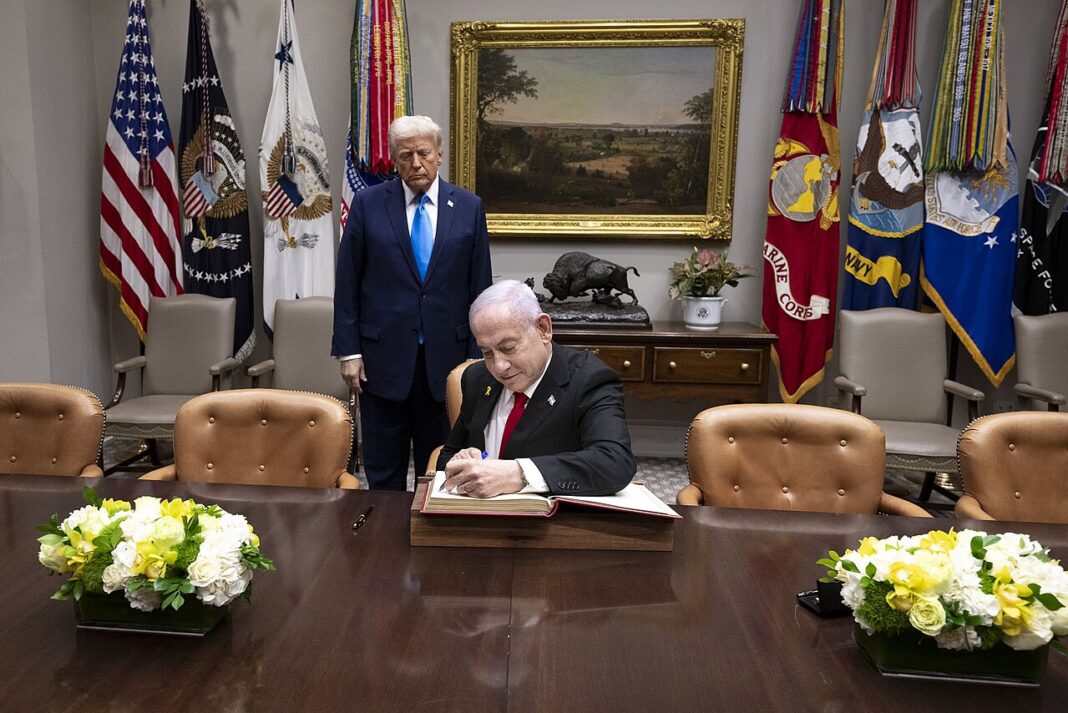
Some have speculated that Trump was ensnared by the suggestion of an assassination attempt by an Iranian cell operating in the US leading to Trump’s “I got him before he got me” remark as reported by ABC News chief Washington correspondent Jonathan Karl. However, reports from various news sources focus on the meeting in the Whitehouse situation room on 11 February 2026, where Netanyahu persuaded Trump to join in an attack on Iran and Trump’s eventual approval for Operation Epic Fury on 27 February 2026.
It is worth noting that in all the deliberations about whether or not to attack Iran, there is no evidence of any stated justification that such a decision would serve wider US foreign policy interests. That then just leaves the stated foreign policy objective of Israeli territorial ambitions as the sole precursor. This was certainly the conclusion of Jo Kent, director of the National Counterterrorism Centre and former chief of staff to the director of national intelligence. In his resignation letter of 17 March 2026, he stated: “Iran posed no imminent threat to our nation and it is clear that we started this war due to pressure from Israel and its powerful American lobby”.
Put colloquially, he confirms what many consider to be self-evident, namely, that the Israeli tail is wagging the US foreign policy dog.