
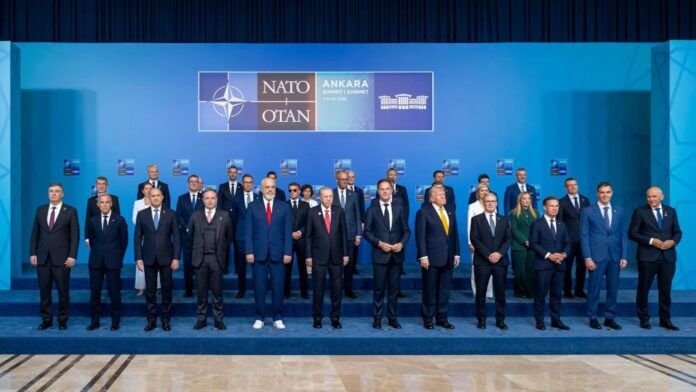
“It was amazing, actually. The unity in that room was incredible, really a love, it was sort of pretty wild.” This wasn’t Donald Trump’s appreciation of a recent ecstasy-fuelled party at Mar-a-Largo, but his assessment of the 32-nation NATO summit held in Ankara this week, finally adding “This was a tremendously successful summit.”
As is now widely acknowledged, Trump’s bluster about Greenland, threats of ending trade with Spain and humiliation of Starmer during the summit were for the domestic audience, as the president struggles unsuccessfully to hold together the 2024 electoral coalition for the mid-term elections this November.
At NATO closed-door meetings, what is really said in the room stays in the room, so NATO’s final Ankara summit declaration was more dull and ordinary, but also for public consumption.
The 480-word, six-point statement focused on the Ukraine war, with £60bn more military aid to Kiev, keeping the Strait of Hormuz open and, pointedly, “We are building the future: a stronger Europe in a stronger NATO,” adding a sentence for the ages, “We are developing an interoperable transatlantic war-fighting cloud and adopting powerful AI models.”
Trump came, he saw and he conquered. In the final press conference, NATO general secretary Mark Rutte spent most of his time reassuring Trump that he was still ‘the Daddy’ in a performance that showed the Dutchman at his cringe-worthy best. Trump railed against all and sundry, NATO allies included, but in particular the Iranian leadership who were described as “scum”.
NATO has always been core to US strategy
Unlike Iran, there of course has never been any real threat to NATO from Trump. In the words of its first secretary general, Lord Ismay, the organisation was launched “to keep the Soviet Union out, the US in and the Germans down” in post-war western and central Europe. He might have added “and to keep the mass parties of the left in their place”. The alliance has always been and will remain core to US strategy.
While Trump likes to speak of NATO as a collaboration with useless allies, in reality it is a partnership of unequals with Washington in the driving seat. Almost two-thirds of European military purchases are made from the United States, so even if some European powers don’t like working with Trump, they would find it impossible to work without the US in what has been a remarkably successful project until now.
Under the Reagan-Thatcher 1980s war drive, the alliance devised a successful strategy to wreck the Soviet Union through military competition. With the fall of the Soviet Union, it evolved a global NATO strategy to police challenges to the US’s authority as the forces of globalisation ripped through Eastern Europe and the global south, upending societies. The bombings of Yugoslavia in 1999, Afghanistan in 2001, crucial back-office support for the 2003 invasion of Iraq and the dismemberment of Libya in 2011, followed.
Unmentioned in the final summit declaration, apart from the elliptical “The Alliance continues to respond and adapt to the strategic competition…” was China, the only major global power to eventually escape the noose of colonialism and US domination in the 20th century.
It is possible, without having any illusions in the Chinese Communist Party, to see why many non-NATO nations welcome its challenge to the United States and its global military wing, NATO. The failure of the US to defeat Iran, which is principally a victory for Iran’s ally China, is for many a multi-polar light at the end of the dark tunnel of US global dominance that followed the end of the Cold War.
Kaja Kallas, chief diplomat of the European Union, commented in an unguarded moment at a Hudson Institute think tank meeting in March 2025: “If Europe cannot defeat Russia, how can we defeat China?” This comment was a glimpse into the realpolitik conversation taking place in the capitals of NATO. To defeat China in the 21st century, Europe needs the United States and the United States needs Europe, and this, of necessity, means a deepening of the NATO war-fighting partnership.
Subscribe to our regular updates to receive the latest articles, analysis and news direct to your inbox at https://theleftlane.media/subscribe/