A new documentary film of Cuba’s history, directed by Matthew Bellen and Abby Martin, Cuba after Castro, is a must-see for anyone interested in learning about Cuban history and the country’s current direction of travel.
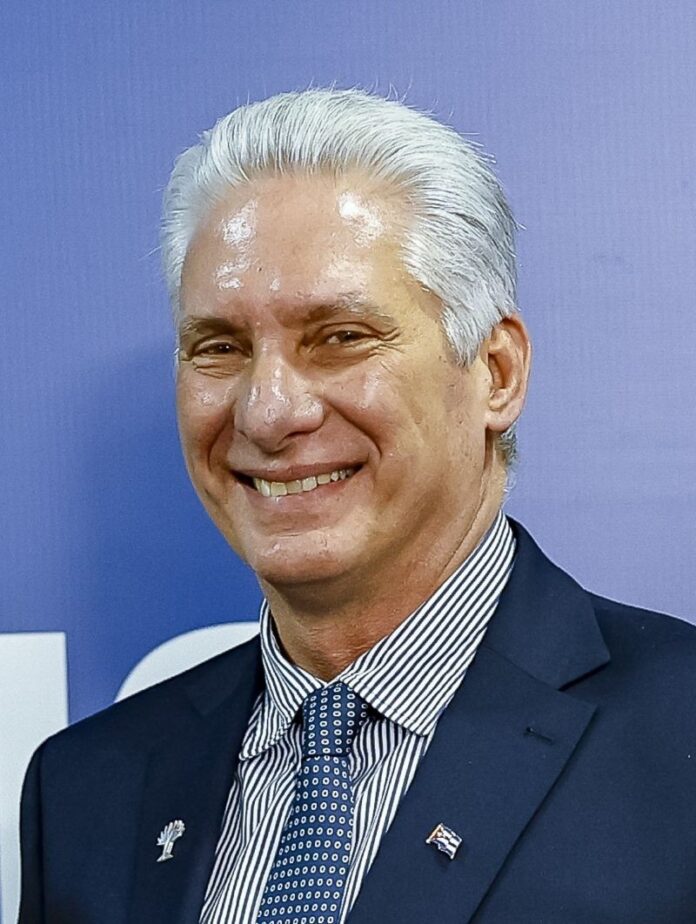
The film is based on Martin’s interview with Miguel Diaz-Canel Bermúdez, elected as Cuba’s 17th president and eighth first secretary of the Communist Party of Cuba, who succeeded Raoul Castro in 2019. Fidel Castro was of course the first president and first secretary of what was the first communist-run country established in the western hemisphere, following the defeat of the Batista regime in January 1959. Interestingly, the president notes that there were Mafia elements involved in Batista’s Cuba, a fact referenced in popular culture, where in Coppola’s The Godfather we see Michael Corleone fleeing a Havana of casinos and brothels as revolutionary forces close in.
There are some excellent film excerpts throughout the documentary, including those of the early post-revolution period, showing a sense of great optimism amongst ordinary Cubans after the oppressive yoke of the Batista regime had been lifted. It reveals how enormous resources were put into their education and training, something that stood Cuba in good stead in future adversity. For example, this poor country was able to provide doctors and teachers to other countries experiencing natural disasters or civic change and film footage shows Cuban support for the Sandinista Revolution in Nicaragua in the 1960’s.
As the documentary makes clear, the current president knew Fidel Castro very well, recounting at one point how he first met him as a schoolboy when Castro turned up unannounced at his school. Anyone watching this documentary will be left in no doubt that the current president is a very level-headed, warm, but sober individual, who sees it as his sacred duty to preserve the principles of the revolution, Cuba’s self-sufficiency and a rejection of what at one point he refers to as the “siren call” of US mercantilism.
A formidable adversary for Trump
Having been born in 1960 and growing up in post-revolutionary Cuba and inculcating its values, Diaz-Canel is clearly a formidable adversary in terms of the current round of sanctions imposed on the island by the Trump regime, which is simply the most recent in a history of failed attempts by successive US governments to subjugate the country. This is, in fact, a stand-out theme referenced throughout the film with perhaps the notable exception of the US under Barrack Obama when there was a degree of rapprochement.
Strikingly in this context, the documentary features two film excerpts 63 years apart, which neatly illustrate America’s persistently perverse attitude towards Cuba. In the first, we see Fidel Castro at the UN in 1960 complaining about, amongst other things, the US bombing of the island. It was a speech notable for its four-hour duration. Fast forward to 2023 and a second excerpt features the current president once again berating the US for its deliberately obtuse behaviour with respect to Cuba.
Journalist Abby Martin notes at the outset that Diaz-Canel is not a household name and although accessible to ordinary Cubans, he rarely gives interviews domestically, let alone to the foreign press. The caution with respect to foreign press is perhaps not surprising given the overt hostility and narrative distortion about Cuba, especially by the US mainstream media, as mapped out during the film. The fact that the Cuban government chose Abby Martin, a US journalist, to interview its president says as much about her perceived political integrity as it does about the Cuban government. But conversely, she does not shy away from asking awkward questions.
One of those questions is about the fact that Cuba, whilst allowing private commerce, does not permit private media companies, implying state control of all dialogue. The president points out what is all too evident in the west, namely that private media simply reflects the views of those that fund it and notes that no one is persecuted in Cuba for voicing dissent about the government or its policies.
“There are many concepts of democracy”
Martin playing devil’s advocate also raises the often-voiced criticism that Cuba is a one-party state and therefore undemocratic. The president notes that there are many concepts of democracy and no doubt with America in mind, what he terms “manipulations of the concept of democracy”. He frames the way Cuban political governance has developed in terms of the need of the Cuban people to throw off the imperial dominance of the Spanish and achieve independence.
In an aside accompanied by film footage illustrating the setting up of workers councils voted for by ordinary Cubans from 1 January 1959, Martin notes that in Cuba there are municipal elections every two and a half years to select delegates from local districts with a high voter turnout of between 70-90%. Interestingly, the Communist party itself does not run the elections.
Elaborating on his initial remarks, the president makes the simple point that no one gets anywhere near government unless they have first been elected as a local deputy in one of Cuba’s municipalities. This of course stands in sharp contrast with, say US, UK or European practice, where anyone with sufficient financial backing can stand as a parliamentary representative and are sometimes ‘parachuted’ into vacant seats a long way from where they actually live.
The film and interview also covers the adversity experienced by Cuba during the Covid period where Cuban scientists were able to develop their own vaccine in the absence of being able to buy vaccines in from abroad due to US sanctions. The president points out that at this time the government of Raoul Castro asked the US if they could buy oxygen from them and simply notes that no reply was ever received from the US administration.
Cuba’s future will be “bright”
Towards the end of the interview, Martin asks the president what the future holds for young Cubans. Diaz-Canel expresses confidence that they will want to contribute to a society which has given them the opportunity to grow and that Cuba’s “will be a bright future – sooner rather than later, we will achieve prosperity happiness and development”. Based on the historical evidence presented, this does not seem an unrealistic assessment.
This wide-ranging and informative documentary is a must-watch for anyone interested in learning more about Cuban history and its current direction of travel. It is also a very welcome antidote to the largely misinformed, intellectually lazy commentary that is so often based on selective evidence that is the usual output of the mainstream media.
Subscribe to our regular updates to receive the latest articles, analysis and news direct to your inbox at https://theleftlane.media/subscribe/