
Andy Burnham says his government is going to put a priority on decreasing the cost of living. Good plan. As a House of Commons library study reported just two months ago, “the cost of living increased sharply in the UK during 2021 and 2022.The annual rate of inflation peaked at 11.1% in October 2022, a 41-year high, before subsequently easing.”
The new PM’s first move was to remove the 5% VAT charge on household electricity bills. That was hardly an ambitious step. Commentators pointed out that this would save the typical household a mere £45.00 per year. So, obviously Burnham needs assistance. And because he “implored his new cabinet to examine ‘all possible ways’ to tackle the cost-of-living crisis”, in the words one newspaper, The Left Lane wants to lend a hand as well.
So here are five tips if Burnham is serious about trying to reduce the proverbial financial squeeze on Brits and if he wants to do as he claims, to make a break with “neoliberalism”.
And for those who think the cost-of-living crisis is a made-up fantasy, read what Thea, a mother of three from London, told the Save the Children charity: “I dread summer. I work five days a week and I do struggle with the extra costs. Sunscreen, replacing outgrown shorts and sandals for three growing children is expensive. I have no budget left for an after-school club for my 11-year-old, and if I’m honest, he’s probably going to end up with more screen time than I am comfortable with.”
1. Tell Trump to halt his war on Iran – it’s driving our energy prices into the stratosphere
This war of choice, which was kicked off on 28 February 2026 by the USA and Israel, is going terribly for the instigators. Intended as a quick and easy win, it has now cost a staggering $37.5bn and Trump this week asked for more funds from the US Congress to keep the war “alive”, if that’s the best word to use to describe a war.
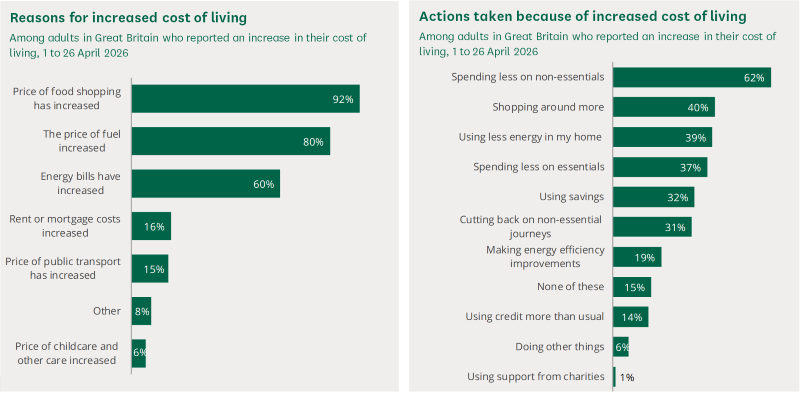
The fact is, however, that Trump’s war is also a major cause of the cost-of-living crisis that we in Britain and in many parts of the world are facing and which is snuffing out any savings we might have. The above graph reveals that two of the top three reasons for the increased cost of living, according to users, were “the price of fuel increased” (80%) and “energy bills have increased” (60%).
No surprise there. The bell weather price indicator, the cost of a barrel of Brent crude oil, has jumped from $71.32 in February to over $95.00 as of today. That’s expected to go even higher in coming weeks according to the Financial Times. Meanwhile back in January, unleaded petrol averaged 131.81 per litre. You won’t find petrol at anything near that price at a pump today. As RAC Fuel Watch reported: “Unleaded petrol prices in 2026 have been highly volatile, largely driven by the Middle East conflict.”
So, if Burnham is seriously interested in reducing the cost of living – and rising energy prices are a key factor in the overall mix – why doesn’t he tell Donald Trump to end his madcap Iranian war? Ending this conflict and reopening the Strait of Hormuz would lead to major decreases in energy prices here in the UK. Ending Trump’s war would be a far more effective price cutter than removing VAT from home electricity bills for a year.
2. Enact rent controls and require more affordable housing
Another cause of the cost-of-living squeeze is the increase in rents all across the UK. In some regions of England, average rents have increased almost 10% in the past 12 months. There are three ways, among others, to keep rent increases in check. One is to bring in rent controls, two is to build more affordable homes and three is to require local councils to mandate a higher percentage of affordable homes in new construction projects.
Angela Rayner, who was the minister of housing for over a year in Keir Starmer’s government, has taken up the same post in Burnham’s new government. She has a decidedly mixed record when it comes to controlling the cost of rental accommodations.
Rayner failed to bring in rent controls when she was previously housing minister. In terms of building more new homes, especially affordable new homes that increase supply and that can lower rents, back in 2024 when it was elected, Labour (and Rayner) promised it would build 1.5 million new homes in England over the life of a five-year parliament. That implies 300,000 new homes a year. However, a government survey for the 2024/ 25 period shows that “around 152,000 to 160,000 new homes were completed across England”. In other words, about one half the target, so it’s worth asking whether Burnham and Rayner will do any better next time around?
A third way to reduce rents, as well as house prices, is for central government to set clear targets for local councils. As Politics Home recently reported, “Previously, all major developments on private land in London needed to include at least 35% affordable housing in order to be ‘fast-tracked’ through the planning system, but in October 2025 [London Mayor Sadiq] Khan agreed with the government to slash the requirement to 20%”. The rationale? The construction industry needed a boost, Rayner’s housing department decided. This is precisely not the way the way to tackle the cost-of-living crisis in housing.
3. Cut the costs of responding to the climate chaos
Now and in coming years, responding to the climate crisis is going to be another leading cost of surviving issue, both for governments and individuals. Yet, Burham shows no appreciation of this beyond typical weasel words. On the one hand, we have heard very little from the new government about what it plans to do to lessen the chances of the coming climate catastrophe obliterating our lives and those of others across the globe. On the other hand, Burnham should ask one of his policy advisors to put this question into his or her favourite AI platform: “What will be the cost to individuals in the UK from growing climate crisis?”
I just did and it spit out over 750 words, with this overall summary: “Individuals in the UK will pay for climate impacts through insurance/housing costs, health impacts, food and living costs, energy bills and lost income. The total bill is likely large and growing, with those who are poorest and most exposed paying the most.” Frankly, Burnham is quite out of touch if he ignores this issue.
4. Increase the minimum wage and make it easier to form a union and bargain for higher wages.
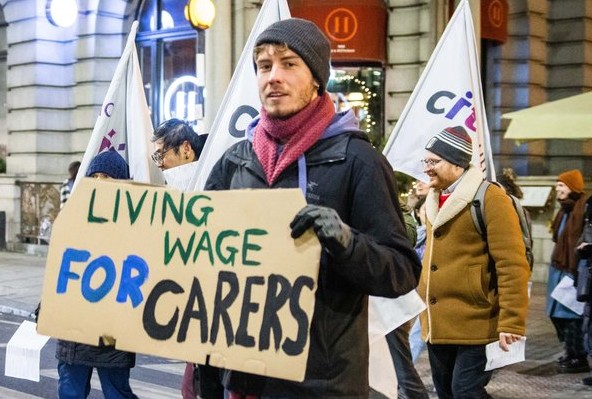
Neither of these measures will, of course, reduce the cost of goods and services. In fact, either might lead to some increases in some costs. But implementing both measures could mean more wages in working-class pockets, especially those with lower incomes. That would be of real assistance on issues like the cost of food and energy. The 15 May House of Commons report found that “low-income households are more affected by high food and energy prices.”
As yet, there is no word, not even a hint, that either of these measures is on Burham’s cost-of-living radar.
5. What about making tax changes?
Changing the tax system can also assist in the battle against the increased cost of living. Over this past weekend, Burnham floated the idea of raising the £12,570 threshold for a tax-free personal allowance. It has remained at the same level since 2021, meaning more people have had to pay taxes as their earnings have increased.
Burnham’s musings would have been popular among those on lower incomes. But by midweek, that change had only become a possibility in the late autumn budget, with the new PM adding that making such a tax move would be “difficult given the financial circumstances in which we find ourselves” and “we’ve got to show fiscal discipline”. After all, new chancellor and ex-defence minister John Healey has a long shopping list of armaments to purchase and especially from Donald Trump’s America.
By Thursday, Burnham was putting “fiscal discipline” behind him when he announced whopping tax cuts for owners of pubs, clubs and most live music venues in England. In a move that will cost the government about £100m, these owners will get a 20% cut in business tax rates starting in April 2027.
That amount of money would replace a lot of “outgrown shorts and sandals” this summer for the children of single mothers such as those mentioned by Thea above. But hey, under Burnham’s regime of so-called “business-friendly socialism”, that attitude would be dismissed as simply “working class envy”.
A fair conclusion? All this talk of operating a “cost-of-living government” is a mere smokescreen and an attempted distraction from more of the same old, same old.
Subscribe to our regular updates to receive the latest articles, analysis and news direct to your inbox at https://theleftlane.media/subscribe/