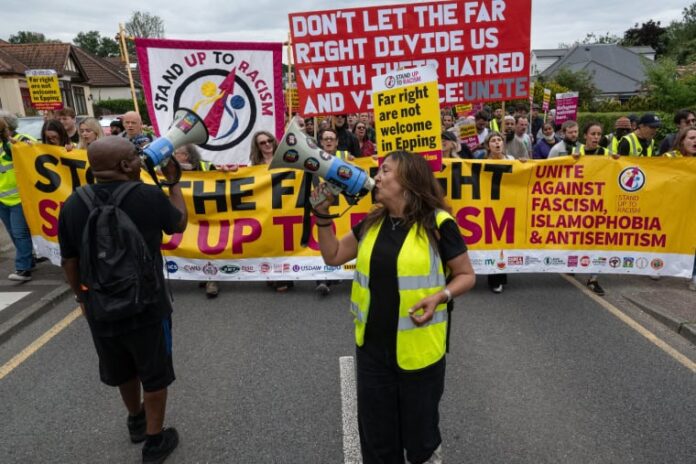
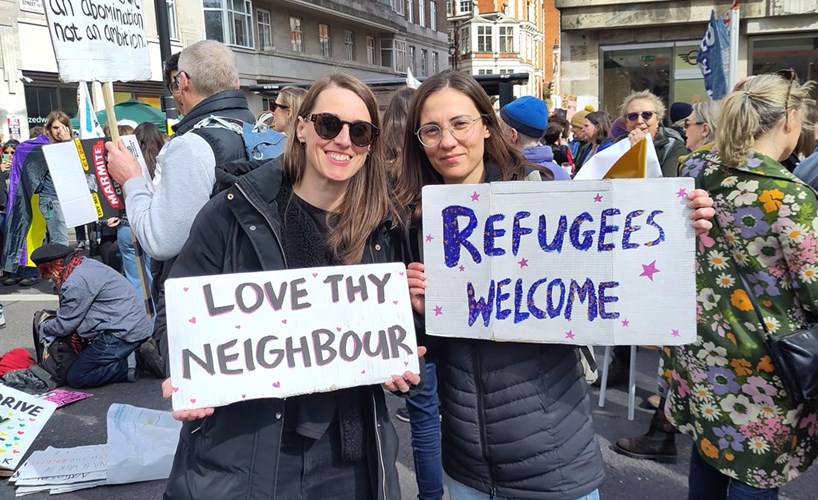
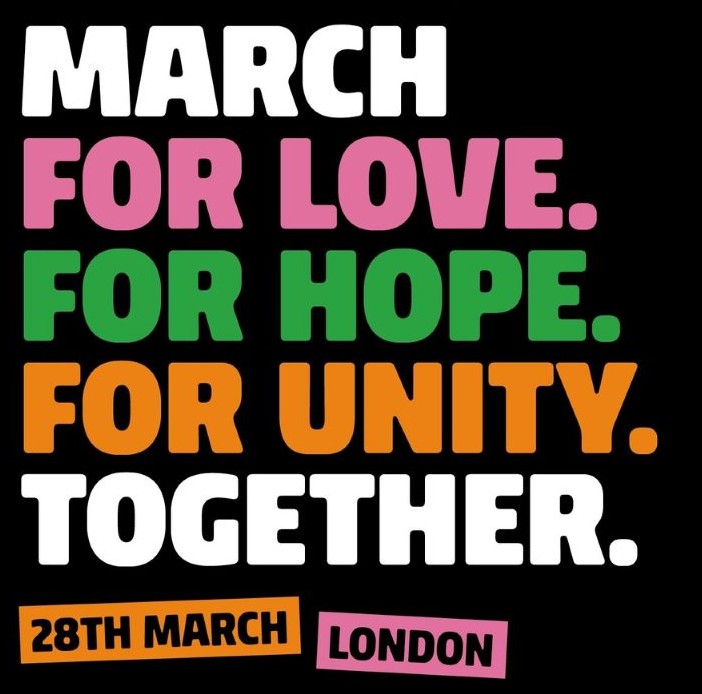
The 28 March 2026 Together Alliance demonstration in London was billed as the big chance to get more people on the streets showing that Britain is against racism than the far right managed last summer, when a march called by Tommy Robinson saw around 150,000 people marching in his support. So, surely getting over three times this number on the streets denouncing far right racism means it was a success, so why carp about it?
The battle of the streets
The demonstration was just the latest in a long line of initiatives, all aimed at ‘winning the battle of the streets’, a strategy dating from the famous 1930s Cable Street mobilisation against Oswald Mosley’s British Union of Fascists. The strategy relies on gathering together the so-called ‘moral majority’, all ‘the people of conscience’ in an overwhelming display of rejection. After the Second World War, it was used to deny a platform to the National Front and to the similar organisations that came after it. It was also promoted by the Anti-Nazi League and Rock Against Racism in the 1970s. Searchlight magazine, which morphed into Hope Not Hate, espoused and organised this strategy most fully.
Over recent years, the Socialist Workers Party has created Stand Up To Racism (SUTR), which focuses on organising both national and city region demonstrations and especially, counter-demonstrations challenging organised racists outside hostels, hotels and elsewhere in multi-racial cities, based on another old strategy, “No platform for fascists!”. However, in my local branch of Your Party, people have questioned whether this strategy is the best way of challenging the far right.
Is confronting the far right the same as challenging British racism?
The routine cry of “Fascists off our streets”, from SUTR activists and others they influence, reveals that this strategy has little or nothing to do with challenging racism in its fullest and most meaningful sense. It is anti-fascist, not anti-racist! This was the case with the 28 March demonstration.
British racism has many component parts, none of which depends on or flows primarily from the succession of fascist and far right organisations since the 1930s. Even if we put aside the attitudes that were inherited from the British Empire, the post-decolonisation decades are a story in the construction of a powerful racist narrative by mainstream politicians, institutions of the UK state and the mass media. This was never the conscious construction of a ‘divide and rule’ strategy, as crude leftist analysis would have it.
The decades during the existence of the National Front and British National Party saw a right-wing focus on halting non-white immigration and initiating the ‘repatriation’ of non-whites who were resident in the UK. It followed in the footsteps of the post-1971 programme of ever more restrictive controls on ‘coloured immigrants. Neither this, nor the more recent focus on stopping asylum seekers and refugees from entering the UK, have ever been seriously challenged by any mass movement.
UK state policy has for many decades been vigilant in erecting a firewall between its immigration control programmes and ‘race relations’, at least up until the turn of the century. Immigration legislation, from 1971 onwards, not only severely restricted non-white immigration, it also created an equation in public debate between immigrants and a ‘problem’, loosely defined as threatening the preservation of ‘British Identity’ and ‘British culture’, neither of which, despite Tony Blair’s best efforts, was ever clarified. Margaret Thatcher had put it directly, saying that British people felt “rather swamped”.
The end of state anti-racist intervention
Blair’s New Labour killed off reformist intervention by the British state to challenge racial inequality and racist attacks. Before this, the 1960s and 1970s had seen the development of legislation to outlaw racial discrimination and set up a new quango, the Campaign for Racial Equality (CRE), to lead on the implementation of this. Jack Straw’s much-vaunted 2000 Race Relations (Amendment) Act, which established statutory duties on all public bodies to promote and practice racial equality throughout their functions, was neutered following consultation with those public bodies, whose senior managers feared the statutory duty they were to be given to fully comply with its detailed provisions.
Tahir Abbas was in the Home Office Race Unit at the time and told me in the noughties that the consultation came back with a resounding message – “lose the teeth!” What followed was that Jack Straw, who was personally compromised by the face-to-face promises he had made to Doreen Lawrence about this legislation, was replaced by David Blunkett, who had made no such promises, in order to be able to take away the CRE’s ability to issue legally enforceable compliance orders. The installation of the willing Trevor Phillips, to run the CRE down ideologically as well as in its capacity, was just completing the job. Blair then abolished it and set up the useless EHRC (Equality and Human Rights Commission) to replace it, citing a move from race to the new mantra of ‘diversity’, which was echoed soon after in every local authority, police force, school and hospital.
The end of local funding for anti-racist intervention
While public debate has touched on the growing democratic deficit at national level, this local deficit is actually even more apparent and occurred much earlier, sidelining local councillors up and down the country, as local strategic partnerships (LSPs) run by senior public service managers took over directing local priorities, targets and delivery. And so, the strategy of black and minority activists getting into local party politics, which took off in the 1980s, on the model of Bernie Grant’s work in Tottenham, ceased to be a viable way forward for black communities or for getting race onto local agendas, because those agendas and the associated decision-making around them were transferred to bureaucratic hands over which they had no democratic control. Worse, the LSPs, set up by Blair in every borough after the 2000 Local Government Act, ensured that challenging racism and racial inequalities was henceforth virtually absent from local plans.
Blair also set up Regional Development Agencies, which sponsored some quite enormous economic development programmes, backed by EU funding, worth tens of millions of public money. It quickly became clear just how absent race was in the development of these. Public duties established by law, albeit neutered, were routinely ignored by the people who tendered for and oversaw the bureaucratic processes through which these massive programmes emerged and there was no democratic body at local or regional level to whom they were accountable. It was bonanza time for small and big capitalists, unfettered by democracy.
Post-Blair British racism – from ‘coloured’ immigrants and black muggers, to boat people, Asian grooming gangs and Muslim terrorists
Britain, from New Labour onwards, has been a place of unchallenged, structural racial inequality. The McPherson Report into the implications of the murder of Steven Lawrence found the Metropolitan Police to be institutionally racist and the same applies to many other parts of the national and local state, especially since New Labour put a stop to state funding for the CRE and pulled the teeth of the 2000 Race Relations Amendment Act.
Most black and minority ethnic communities are, in Marxist terms, a major part of the reserve army of labour – the surplus population – but in a capitalist society which is no longer a significant producer for most areas of the market, there seems no prospect of being called up, except for the most precarious roles in employment or self-employment, a prospect shared by the poorest fifth of the white population. It is this status which has been institutionalised for the black community by the failure and ending of the post-war reformist project on race, initiated under Harold Wilson’s 1966 government by the Liberal Roy Jenkins.
The rise of anti-EU campaigning, especially after the 2008 credit crunch crisis, became, in fact, mostly a campaign against the number of EU workers from Eastern Europe in Britain, which culminated in Gordon Brown’s “British Jobs for British workers” campaign and the 2015 referendum on EU membership. By the time of the referendum, EU migrants had been replaced by asylum seekers and refugees as the main racist bogeymen. In altered form, the British xenophobic fear of ‘our island’ and its culture being ‘swamped’ by aliens returned to the centre of politics. Once these had been Jewish refugees from pogroms in Romanov Russia, barred by the 1902 Allies Act, then it was the legislation to keep out ‘coloured’ immigrants from the Caribbean and Indian sub-continent. Nowadays the political class and mass media are consumed by the fear of boat people.
New Labour also brought about another key development – the increasing political and economic marginalisation, poverty and deprivation levels of white males, abandoned by turn of the century New Labour and hit so hard afterwards by Tory austerity, with none of the internal social cohesion of, for instance, British Muslims, many of whom do live in actual communities with shared values and culture. The mostly white estates of towns and cities became ghettoes of deprivation and abandonment, along with ex-mining towns and villages, coastal towns and other deprived areas. Nigel Farage has said repeatedly that his mission is to give them a voice – albeit the voice of a desperate, racist, blaming culture. Their anger is palpable, with a degree of violence in the summer of 2025 which was almost sociopathically cathartic.
The other development dating back to New Labour derives from the ‘war on terror’ launched by Washington and London in response to 9/11. Tory prime minister David Cameron dubbed it “a generational war against political Islam”. This was not just about wars fought against Muslims in Afghanistan, Iraq, Libya, Palestine and, most recently, Iran, but also the domestic agenda that was its corollary. Under Blair, this took the form of not only the notorious terror legislation that most recently resulted in the ‘proscription’ of Palestine Action and Hamas, but also the ‘Prevent’ programme, a means of criminalising and ‘de-radicalising’ young Muslim men, in particular. The noughties also saw the rise of the Asian grooming gang scare stories, a particular favourite of right-wing culture warriors and far-right influencers for the past two decades.
Racism is a far bigger problem than the far right, but how should we challenge it effectively?
Racism, as distinct from racialism, refers to the structural, material and historical processes, systems and political realities that exploit, expropriate, discriminate against, incarcerate, rob and enslave the groups of people concerned. Some leading examples are the slave trade, the mediaeval European laws prohibiting Jews from most professions and trades, the ethnic cleansing by white Europeans of the native Americans, the white Australia policy, South African apartheid, the anti-Muslim crusades of mediaeval Europe, the grossly disproportionate representation of African Americans in the US prison system, the deliberate destruction of the Indian cotton industry in order to encourage cotton manufacture in Lancashire and the genocides in the Belgian Congo, Armenia, the Third Reich and in Palestine.
These are all forms that racism has taken and takes. Racialism on the other hand refers to the social and cultural consequences of racism, to the justifications given for this racism, to the explanatory framework used by the direct perpetrators of it for what they have done or do to other groups of people. It is the stories they tell themselves and others about the relative humanity and entitlements of themselves, compared to the people they have abused, robbed and mistreated.
These ideas become ingrained in the societies that have been involved in developing racist structures like empires, slavery, apartheid, immigration policies, rendition procedures, concentration camps, reservations, racist state institutions and so on. Northern Irish protestants still celebrate the battles fought over 300 years ago to establish their state and their privileged status within it. Many British politicians still look back fondly to the days of the British Empire. Jews are still seen by many people as wicked moneylenders who control the world. Black people are seen as overly aggressive or not particularly intelligent and Muslims are nowadays typecast as women-hating potential terrorists.
It is this racialism that some people think can be countered by education, by diversity policies and programmes, by the invention of ‘hate crime’ by re-defining antisemitism and the holocaust, redefining terrorism and by spreading liberal tolerance, witch-hunting racists and so on. ‘Anti-racism’ has moved since New Labour, from a concept relating to fairness, equality and justice, to an exercise in purging people’s minds of ‘impure thoughts’ and indeed purging such people from employment and from political parties.
Final thoughts – and a way forward?
None of these responses to racialism have worked. Racialist attitudes not only persist but have strengthened, because racialism sits on top of the material, structural, contemporary and historical reality of racism, which was and is built and maintained by those with the power, the influence and the wealth to bend reality in ways that benefit them, at the expense of others. This is what fuels far-right movements, not the other way around.
Challenging racism means working strategically to dismantle, topple and replace the material, structural, accumulated realities of racism. Post-war history shows that this cannot be done by gradual reform, without dismantling other structures and levers of power simultaneously, or else they will undermine and overrule any gradual reforms, as New Labour and its bureaucracies did at the turn of the century.
The 28 March demonstration in London made a lot of people on the left feel better and gave further impetus to SUTR, which has positioned itself at the head of the ‘old-fashioned’ anti-fascism of Cable Street, but even if this anti-fascist strategy could reverse the success enjoyed by the current far right and even if the resurgent Green Party can outpoll Reform UK in the next general election, racism and racialism will still sit triumphantly right at the centre of British culture and politics. We have to recognise what it really is, how it was built and why – and grasp clearly what has and what has not worked in challenging it over the past half a century.