As communities in Belfast and Southampton grapple with recent racist violence and tensions on their streets, this week’s 48th anniversary of the racist murder of Ishaque Ali in east London offers a powerful reminder of one lesson above all else – that racism and the far right can only be defeated through collective resistance and solidarity.
On 26 June 1978, Ishaque Ali, a Bengali clothing worker, died from injuries sustained in a brutal racist attack in Hackney. His murder became a rallying point in a summer of resistance that saw demonstrations, strikes and growing working-class organisation against racism.
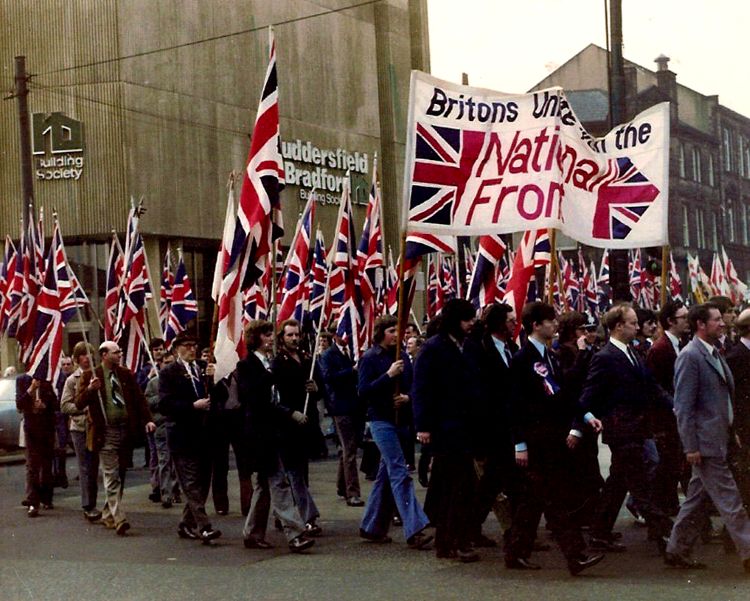
At the time, the National Front (NF), a far-right white supremacist party, was attempting to establish itself as a significant force in east London. Targeting areas with large immigrant populations, it used marches, street sales and racist propaganda to intimidate communities and recruit supporters. Then, in a highly provocative move in September 1978, the NF shifted its headquarters to nearby Shoreditch and sought to maintain a regular presence in Brick Lane, which was then right at the heart of London’s Bengali community.
But the fascists encountered determined opposition. Ishaque Ali’s murder, alongside other racist attacks and killings, helped galvanise a mass anti-racist movement that united Bengali workers, trade unionists, socialists, anti-racist campaigners and local residents. Through protests, workplace action and community self-organisation, they made it increasingly difficult for the NF to operate. Their struggle demonstrated that racism is most effectively challenged through collective action and solidarity across communities, a lesson that remains as relevant today as it was nearly half a century ago. I certainly learned from these events.
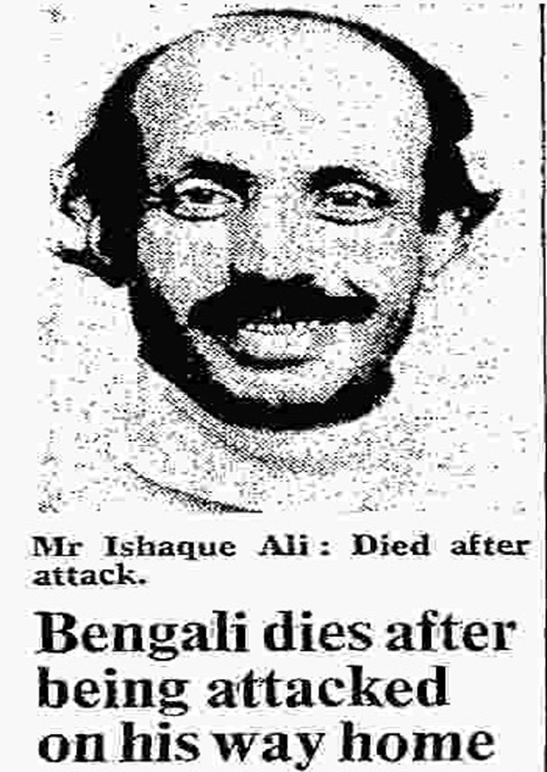
Ali’s murder was not a murder, said the Met
In the early hours of 25 June 1978, Ishaque Ali, aged 45, and his 20-year-old brother-in-law, Faruk Uddin, were attacked near Ali’s home on Urswick Road, Hackney. The two men were returning home when three white youths confronted them. Reports at the time said that they were severely beaten and one reliable account stated that a shoelace was used in an attempt to strangle them.
A father of five, Ali collapsed with a heart attack and died around 3.30am after being taken to the hospital. (For more on the story and community reaction, see John Eden, The racist killing of Ishaque Ali in Clapton in The Radical History of Hackney (2022)).
The attack took place amid a wave of racist violence across east London. Bengali families regularly faced harassment, assaults and intimidation, while the National Front sought to establish a visible presence in working-class neighbourhoods.
Racism and official indifference from the Met
The police investigation quickly became controversial. Senior officers suggested robbery rather than racism was the motive for Ali’s death. However, family members and anti-racist campaigners strongly rejected this explanation. Relatives pointed out that nothing had been stolen. Activists reported that racist abuse had been shouted during the attack. For many local people, the response reflected a wider failure by the authorities to recognise the scale of racist violence facing Black and Asian communities.
Ishaque Ali’s cousin Sofar ud Din told the Hackney Gazette: “He was attacked because of his colour. There was no money taken. It happens all the time in the East End”.Alok Biswas of the Socialist Worker Party, who knew the family, said: “Faruq, who is recovering in hospital from his severe beating, told me that the white youths called the two Bengalis ‘Paki bastards’ and ‘stinking blacks’.
Their attackers only left when a West Indian man who was passing in his car came to their aid. Had it not been for this man, Faruq would also be dead. Alok Biswas also noted that the family was not aware of Ishaque Ali having any heart problems.
People will come to their own conclusions about this, but given what we now know about the policing in the late 1970s and the general culture of the time, it seems unbelievable that racism played no part in the incident. As for today, let’s not forget that a very detailed report in 2023 concluded that the Met was still “institutionally racist”.
Biswas, who was also the secretary of the Hackney Asian Association, expressed his concern that his fellow countrymen living in Hackney were being targeted by racially motivated attackers who were moving into Hackney from their previous haunts in Tower Hamlets, where attacks on Bengalis took place regularly. Patrick Kodikara of the Hackney Council for Racial Equality told the Hackney Gazette that confidence in the police’s ability to protect ethnic minority communities was rapidly declining.
The community gets mobilised
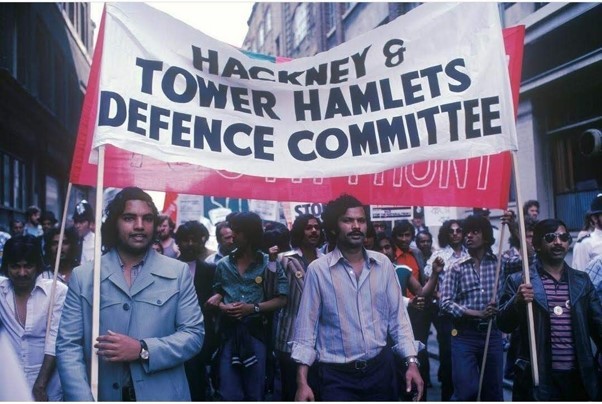
Ishaque Ali’s death prompted an immediate response. On 30 June 1978, around 300 people marched from the site of the attack to Hackney police station carrying black flags and wearing black armbands. The demonstration was organised by the Hackney and Tower Hamlets Defence Committee.
In the weeks that followed, anti-racist activists in Hackney and Tower Hamlets intensified their organising. Supported by the Anti-Nazi League, local trade unionists and socialist campaigners, they built a broad movement capable of challenging both racist violence and the far right.
On 16 July 1978, campaigners staged a sit-down protest in Brick Lane to stop NF members selling their newspapers. The following day saw a major strike and a “Black Solidarity Day” against racism.
Between 8,000 and 10,000 people in total joined rallies and demonstrations. Trade unionists, students, Grunwick strikers and Ford workers marched alongside Bengali residents. Asian-owned businesses across east London closed in solidarity. The movement reached another high point on 20 August 1978 when around 5,000 people joined a major anti-racist march through the East End.
Convicted on relatively minor charges
Three young men were eventually arrested for the attack and charged with murder. They were James Mitchell, 17, a cabinet maker from Kentish Town Road, Camden and two 16-year-old males from Homerton. A year later, in September 1979, the three accused were found guilty, not of murder, but of assault with intent to rob and actual bodily harm (ABH). They were sentenced to six months for each offence to run concurrently. ABH is a lesser charge than grievous bodily harm (GBH).
Yet the questions remain. First, how did a case that began with murder charges end without a murder conviction? Second, why did the three guilty killers receive such relatively light sentences of only six months in jail? For many in the Bengali community and the wider anti-racist movement, the outcome raised serious questions about whether justice had been served and whether the criminal justice system had properly recognised the gravity of the attack that led to Ishaque Ali’s death.
Other local people of colour killed in 1978
Ishaque Ali was not the only victim in 1978. The same year also saw the racist killings of Guyanese teenager Michael Ferreira in Hackney and 10-year-old Sikh schoolboy Kennith Singh in Newham. These attacks exposed the deadly consequences of racism during a period of economic crisis and growing far-right activity. The parallels with today are striking. But these racist killings also helped generate one of the most important anti-racist movements in modern British history.
The campaigns that followed united Black, Asian and white working-class people in a shared fight against fascism, racism and institutional indifference. They showed the power of solidarity on the streets, in workplaces and across communities and helped build a mass movement against racism and fascism.
In the summer of 2026 on the hot streets of Britain, the chances of racist murders occurring are, sadly, quite high. Let’s be ready to respond as one and remember how, 48 years ago, ordinary working people, trade unionists, community activists and young Bengali residents came together to challenge racism and the far right.
When communities come under attack, the answer is not fear, division or silence, but solidarity, organisation and collective action.
Subscribe to our regular updates to receive the latest articles, analysis and news direct to your inbox at https://theleftlane.media/subscribe/