
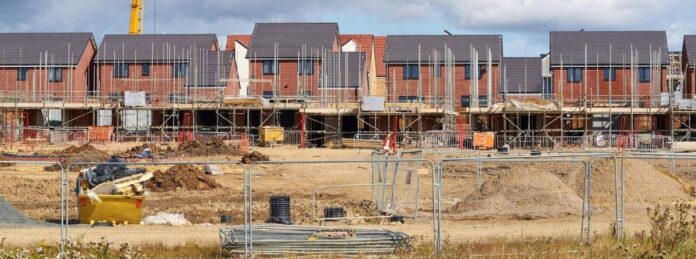
One of the key priority issues for the new prime minister, Andy Burnham, is the country’s housing crisis. The problem he faces, but has not yet admitted to, is that once a housing market has been financialised – once prices, rents and land values have been deliberately elevated and propped up – it is very difficult to reverse without precipitating a financial crash.
Before we get to that problem, let’s knock one issue on the head – this is not a crisis of housing shortage. It is a crisis of ownership.
Britain doesn’t have too few homes. It has too few homes going to the people who need them
This was revealed in the 2011 census, which for the first time counted the number of bedrooms in every household. It identified 23.4 million households in England and Wales, with an average of 2.4 people and 2.7 bedrooms per household – 12% more bedrooms than people.
Adjust for couples sharing a bedroom and the surplus jumps sharply, to somewhere between 1.3 and 1.4 bedrooms for every person sleeping in the country. And because the census only counts occupied homes, every empty property – including the second and third homes of the wealthy, vacant most of the year – pushes that surplus higher still. The conclusion is stark. England and Wales already have enough housing stock. It is simply distributed in the wrong hands.
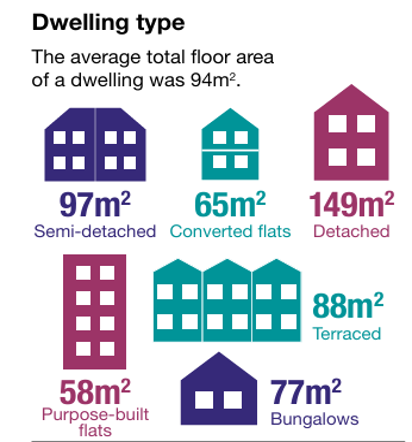
The graph above shows the distribution of bedrooms by dwelling type. Detached houses – the largest category, and the one containing most second and third homes – are followed by semi-detached properties. Flats and converted flats, roughly half the floor area of a house, make up the smallest share.
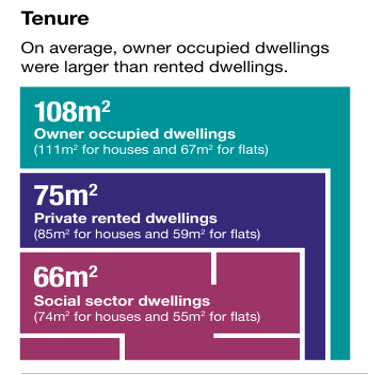
The graph above shows the tenure of these dwellings. Just over a quarter is social housing of one kind or another – and most of that is legacy stock, built decades ago, rather than anything built recently, as the construction figures below make clear.
It’s also worth noting that homes themselves have shrunk. Average dwelling size today is more than 10% smaller than in the 1950s and 60s and gardens have shrunk with them. Back then, municipal architects were instructed to build homes families could grow into, with gardens large enough for children to play in.
Two crises, one playbook
Social housing construction has been gutted twice, each time using a financial crisis as cover.
The first came after the manufactured Sterling crisis of the mid-1970s, engineered by the Bank of England and the IMF, which the Labour government used to end the postwar social-democratic settlement. Municipal housebuilding collapsed by 75% in its wake.
The second came after the 2008 financial crash, when the Conservatives socialised the banking sector’s losses through austerity – with social housing spending among the first casualties. A House of Commons study documents the fall in detail. In both cases, a banking crisis was used as the pretext to withdraw from a housebuilding programme that had nothing to do with causing it.
The cumulative cost is stark. Comparing average construction rates before and after 2012, England lost around 260,000 social homes that would otherwise have been built, plus another 50,000 through reduced acquisitions – 310,000 homes in total. Had they been built, the current housing waiting list of one million would be a third smaller, saving tens of billions of pounds in housing benefit and council emergency housing costs. It is a casestudy in neoliberalism being penny-wise and pound-foolish – and it is also the source of the near five million-home shortfall in social housing stock that has accumulated since 1977, when municipal building last ran at its postwar pace.
Why scarcity is the point, not the problem
This is where the two threads meet. The fall in available housing – as distinct from the housing that exists – is a direct result of the collapse in social housing construction. Financialisation depends on scarcity, or at least on a supply that can be controlled, and municipal housing was the one part of the market where that control could be exercised. An unrestricted programme of council housebuilding would break the financialisation of housing outright – which is exactly why, for successive governments, it wasn’t allowed to happen.
The consequence has been a housing cost that has risen three- to five-fold relative to income since the 1960s, depressing living standards for renters and buyers alike. It has not depressed the profits of housebuilders or mortgage lenders – quite the opposite, with the “big six” monopoly builders posting record profits and share prices throughout.
The trap Burnham has walked into
Financial capital and volume housebuilders are now addicted to high prices. A genuine surge in social housing supply, of the kind needed to unwind the crisis, would collapse prices – and with them, the collateral underpinning the mortgage market and the profit margins of the major builders.
The knock-on effects would not stop there. Housing accounts for up to 40% of household wealth, more than pensions (30%), and most of that wealth sits in owner-occupied homes. A serious fall in prices would force mortgage lenders to demand more collateral from borrowers, curbing their spending, while owners – feeling poorer as their main asset lost value – would cut spending further still. This is the real stakes of Burnham’s pledge, not the mortgage-rate and gilt-yield effects being discussed in Westminster, but the risk to house prices themselves.
None of this began with Thatcher, as is commonly assumed. The financialisation of British housing starts with the Callaghan government’s response to the Sterling crisis in 1977. Unwinding it now would mean the state stepping in to secure the banking and mortgage sector against a collapse in house prices it could not otherwise survive. Any left programme of municipal housebuilding, in other words, has to come with a demand to bring the financial sector under public control alongside it – or risk triggering another 2008.
No doubt the banks and the civil service will counsel Burnham to proceed prudently, in keeping with his promise to stick to fiscal rules. Every prime minister before him has arrived promising to fix housing – Starmer pledged 1.5 million new homes – and every one of them has failed.
The difference is that Burnham has made housing his defining pledge. In doing so, he may have signed his own political death warrant – within months, he risks becoming a younger, more jovial Starmer and, like Starmer, just as discredited.
Subscribe to our regular updates to receive the latest articles, analysis and news direct to your inbox at https://theleftlane.media/subscribe/