
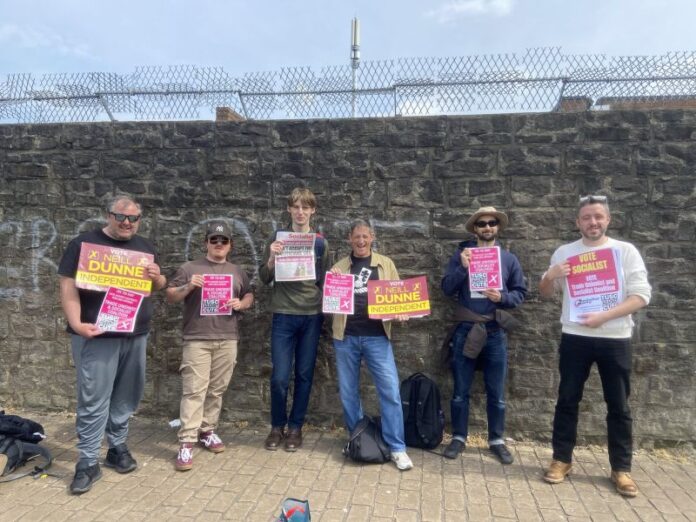
With Your Party mustering only two dozen official candidates for the impending local elections, by far the largest socialist representation has been assembled by the Trade Union and Socialist Coalition (TUSC). The coalition first contested elections in 2010 and is fielding some 300 candidates this year. Only the big five national parties – Reform, Labour, the Tories, Greens and Lib Dems – have registered more candidates. TUSC’s leadership openly invited Your Party members, who could not be verified in time, to stand under their banner. At least 27 took up that offer. This may explain why TUSC members have so far not been disqualified from holding dual membership of Your Party.
In previous years, the numbers assembled by TUSC have been similarly impressive, though once again a significant percentage of their candidates will exist only on paper. This factor is raised by critics when their relatively low votes come under discussion. Your Party and aligned independents will likely stand only in wards where they are directing some resources. Furthermore, TUSC has struggled to make an impact campaigning in areas where they had hoped to fare better. Dave Nellist, the highly regarded former Coventry MP, has failed to register above 10% in his last few outings in the city’s St Michael’s ward.
TUSC is not the only left group to have experienced marginalisation at recent elections and there are signs that they might enjoy an uptick in fortunes this year. Being the most prominent explicitly socialist grouping could help them benefit from the shattering of the historical allegiance to Labour. Their anti-austerity position might capture left voters whose attitude to the Green Party has been soured by its enabling of cuts to vital services when that party controlled local governments in Bristol and Brighton.
One city where TUSC is targeting is Southampton. Standing in the inner city Bevois ward in 2024, Nadia Ditta achieved 32.2%, coming second behind Labour veteran and former deputy council leader, Jacqui Rayment. She is a popular figure in the community. A recent ‘Ladies Tea Party’ attracted 70 attendees, who discussed housing, leisure facilities and the struggles of working women, alongside opposition to war in the Middle East.
TUSC is continuing to give critical support to the Your Party project. Pete McLaren, a leading member, believes it “remains potentially the new mass socialist party TUSC is committed to create,” but “the undemocratic and increasingly dictatorial nature of Your Party’s leadership has undeniably put strains on our relationship to it”. He concludes that TUSC should “remain a supportive element within Your Party whilst constantly reassessing what purpose that achieves”.
A notable standpoint of TUSC is its insistence on the central role of trade unions in any new left party. McLaren pointed out that a number of leading union members sit alongside him on the steering committee, adding that “the failure of Your Party so far to appreciate the significance of trade unions in the struggle for socialism has been a major setback”.
Going forward, TUSC may find itself filling some of the space created by an exodus of members from Your Party. The group has experience of running large election campaigns, which they have persisted with despite disappointing results and the withdrawal of financial support from the RMT union.
At present its campaigning outside of election periods is minimal. Its remit will almost certainly need to expand to attract sustained engagement with a core of socialist activists desiring a long-term project. People leaving Your Party because of the actions of its central bureaucracy will be wary that TUSC remains significantly influenced by the Socialist Party. The Socialist Workers Party was affiliated until 2017, when they separated over the issue of standing candidates against Labour, at the time under the leadership of Jeremy Corbyn. Their re-affiliation, should it occur, might pave the way for a more inclusive coalition. Further information about TUSC can be found at www.tusc.org.uk/