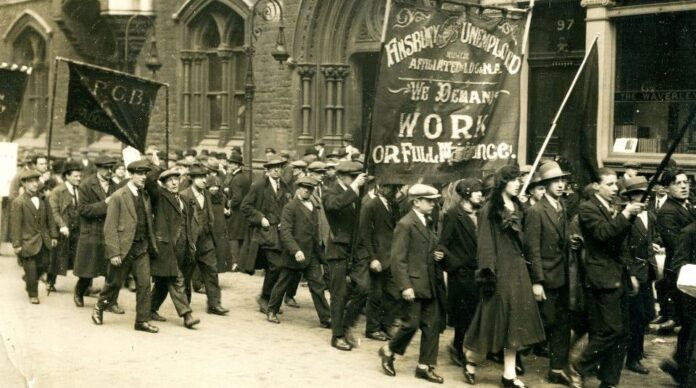
Today is the 100th anniversary of the 1926 General Strike. It lasted nine days from 4 to 12 May, being called by the Trades Union Congress (TUC) in an effort to force the government to prevent wage reductions and worsening conditions for 1.2 million locked-out miners. Some 1.7 million workers answered the call.
Perceptions of the strike, at the time and after, variously range between an ignominious defeat to a tremendous act of solidarity, between Britain on the brink of revolution and experiencing a mild disruption and between the heroism of rank-and-file workers and a sellout by the TUC bureaucracy, supported by the not-long-founded Communist Party of Great Britain. The truth probably lies somewhere in between all of those binaries.
Back then the economy was overwhelmingly powered by coal, hence, the term, the ‘coal age’. This gave the mine owners tremendous power and wealth. But all was not well for them. They were about to feel the cold winds of economic change.
The first world war (1914-1918) saw rising coal production to meet the demands of industry for war production. The best seams were mined, and exports of coal consequently fell. This led to competitor countries, like the US, Germany and Poland, filling the gap in overseas markets. And with lack of investment by the mine owners, productivity per miner had been falling constantly since the 1880s. German war reparations involved exporting its surplus coal, so prices fell further.
“Not a penny off the pay, not a minute on the day”
All this created a perfect storm where mine owners knew of only one way to square the circle, namely, by making the miners pay the price to protect their profits. Prior to 1926, miners’ wages fell from £6 a week to nearly £3 a week. Come another wage cut, the miners resisted again saying, in the words of their leader, A.J. Cook, “Not a penny off the pay, not a minute on the day”.
The TUC pledged its support for the miners with the result that the Tory government decided to intervene by declaring that a nine-month subsidy would be provided to maintain the miners’ wages and that a royal commission would examine the problems of the mining industry and consider their impact upon other the economy and society.
The commission published its report on 10 March 1926 recommending that national employer-union agreements, nationalisation of royalties and sweeping reorganisation should be considered for the industry. But it also recommended reducing wages by 13.5% and withdrawing the government subsidy. The government said it would accept the report if other parties also did.
The mine owners declared that miners would be offered new terms of employment, which included lengthening hours and reducing wages. The miners refused those terms, being locked out from 1 May 1926, and the TUC pledged to organise a general strike in their support albeit limited to railway, steel and transport workers and printers.
The government had been preparing for the strike over many months previously by creating the likes of the Organisation for the Maintenance of Supplies, organising strike-breakers and being prepared to use the Emergency Powers Act 1920 to maintain essential supplies. On 4 May 1926, the number of workers on strike surprised both government and TUC, with local committees organising pickets, food and newspapers to aid communication. The government attacked the strike as a revolutionary uprising and a challenge to the rule of law, king, country and constitution.
The government had something of a case for the latter point but only because the Trade Disputes Act 1906, which granted unions immunity from prosecution for organising strikes, only gave immunity for those strikes “in contemplation of a trade dispute” over wages and conditions between employer and employees. Striking by those not directly involved, in the form of solidarity or sympathy strikes and political strikes were exempted.
The TUC responded to the Tory onslaught with: “We are not making war on the people. We are anxious that the ordinary members of the public shall not be penalised for the unpatriotic conduct of the mine owners and the government”.
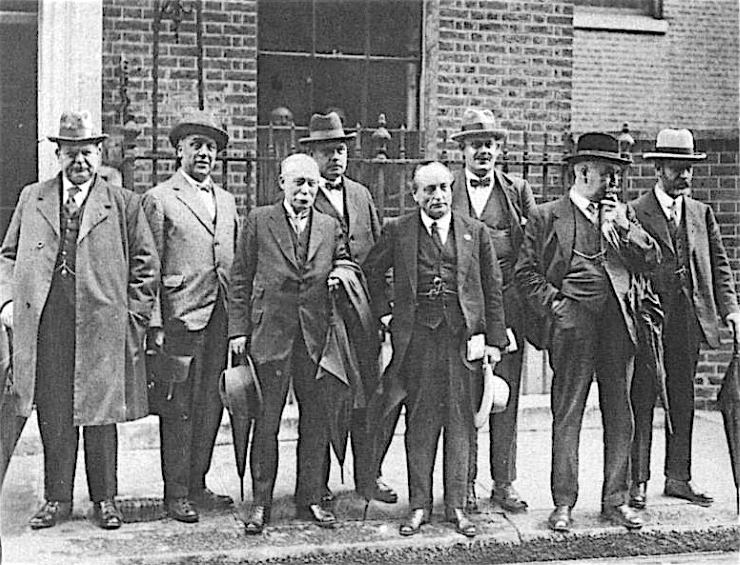
On 12 May 1926, the TUC visited 10 Downing Street to announce its decision to call off the strike if the proposals worked out by the commission were respected and the government offered a guarantee there would be no victimisation of strikers. The government stated that it had no power to compel employers to take back any or all strikers. Yet, the TUC then agreed to end the dispute without such an agreement. This left the miners to fight on, on their own.
There are various reasons why the strike ended almost as it seemed to just get going. In the TUC, there was some fear of the strike being out of its control given that the strike was organised locally by grassroots members.
Certainly, the government had made good on its resolve to undermine the strike with its prior preparations and there was an uncertainty about whether unions other than the miners’ union would be prosecuted and fined for the unlawful nature of the strike. There was also some degree of conservatism amongst some of the national unions so that internal divisions opened up about continuing the strike.
The miners maintained their resistance for many months, before being forced back to work by destitution, but many were refused re-employment. Those that were re-employed were forced to accept longer hours and lower wages. The Tories capitalised on the strike’s defeat by creating the Trade Disputes and Trade Unions Act 1927, which further outlawed sympathy strikes, general strikes and mass picketing.
Fortunately, the strike defeat was not the death knell for unions despite the Great Depression of the 1930s that was to come. The demand for labour during the second world war (1939-1945) allowed unions to strengthen and re-assert themselves. After the end of the war, union influence increased substantially and played a major part in influencing the complexion of what became known as the great reforming Labour government (1945-1950), led by Clement Attlee. This was the government that nationalised major parts of the economy and established the NHS.