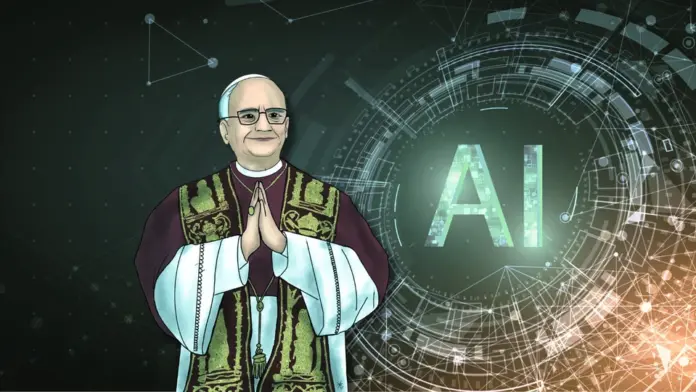
“Humanity, created by God in all its grandeur, is today facing a pivotal choice: either to construct a new Tower of Babel or to build the city in which God and humanity dwell together.” This gem of a sentence begins Magnifica Humanitas – On Safeguarding the Human Person in the time of Artificial Intelligence, an encyclical published by Pope Leo XIV on 25 May 2026. While an encyclical is defined as a letter sent by the Pope to his bishops, this significantly undersells the significance of Leo’s 40,000-word essay on the subject of AI.
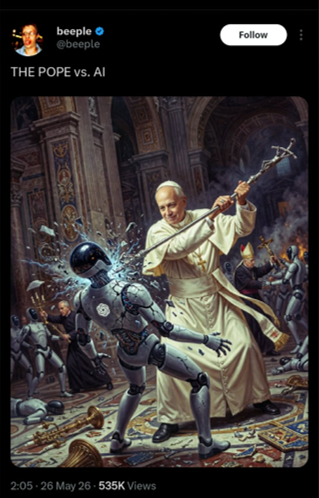
Essays about Catholic theology rarely reach a wide audience, but this piece, which cites sources as diverse as Saint Augustine’s Confessions, Hannah Arendt’s The Origins of Totalitarianism, and JRR Tolkien’s The Return of the King, has taken the internet by storm. Whether many of the influencers posting memes showing the Pope fighting AI (see image below), or claiming that they were cancelling plans to read the encyclical, actually read the thing or not is unclear, but hopefully they did.
Why the Pope matters
Critics of the Pope like to point out that he is one of the world’s last remaining absolute monarchs, but unlike nearly every monarch in history, his power and wealth are neither inherited, nor won through war. The Pope sits atop his throne by virtue of his ability to win recognition from his peers as an authority on Catholic moral teaching and as someone capable of earning love and support from his flock of over a billion people.
Where the Pope differs most from other world leaders is not that he was chosen by an electorate of just over 100 cardinals, or that he fits some technical definition of ‘monarch’, but that he tries to win popular support with serious philosophical arguments. For capitalist politicians, morality and ideology are of interest only as part of a marketing strategy, wheeled out before voters every four or five. It is no wonder that every generation of politicians seems less capable than the last of making a coherent argument for their politics and that their values never seem to hold in place for more than a few moments.
Once upon a time, socialist leaders took philosophy a bit more seriously. Marxists understood that the role of the party was to uplift the consciousness of ordinary people and Lenin (pictured below) devoted almost as much time to reading and writing political theory as he did to running the Bolshevik Party. Those days are over now. While the writings of Xi Jinping single him out as an intellectual giant, compared to the likes of Trump and Starmer, they cannot be compared to the output of Lenin or Pope Leo. Jeremy Corbyn has earned a reputation as one of the most principled men in British politics, but his purported principles have never been explained in any depth.
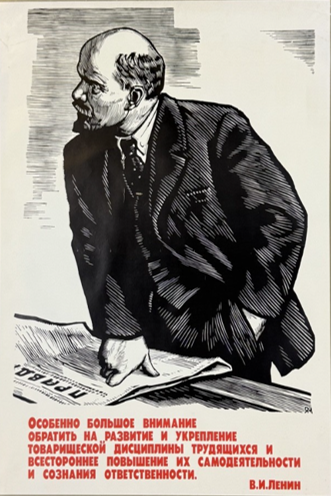
Socialists may want to oppose the Pope as a reactionary, or as someone who draws his views from an irrational faith in a Palestinian magician who died 2000 years ago, but when he stands alone as the only leader who cares about serious philosophical debate, we should have that debate with him.
What the Pope said
Pope Leo spends the first chapter of his essay explaining Catholic social doctrine. Social doctrine, he says, is the result of what he calls a dialogue between the Gospel and human knowledge. Social doctrine therefore, is not a rigid set of rules laid down by the church, but must continue to develop, as humans learn more about themselves and their universe and as they face new problems to overcome.
The current Pope took his name from an earlier Pope Leo, who he credits as the founder of Catholic social doctrine. As recognised by Pope Leo, his namesake developed social doctrine in 1891 as a response to the intensification of class struggle. While Leo XIII was hardly a Marxist, the lesson that Leo XIV draws from his work places him firmly on the left of the political spectrum; human labour must have primacy over “any mindset focused solely on finance or productivity”.
As Leo XIV goes on to explain, this view was developed by Saint John Paul II, who argued on the one hand that workers should be paid fair wages and on the other that work was a fundamental good. Through work, “human beings bring their freedom, creativity and capacity for cooperation into play”. John Paul was a vicious opponent of Marxism and played an important role in overthrowing ‘socialism’ in Eastern Europe. His demand for dignified work, however, also puts him at odds with the western capitalist system that has brought poverty and unemployment ever since.
After a second chapter, in which he outlines the importance of recognising the equal dignity of all people and the need to work towards the common good, Leo begins applying social doctrine to the issue of AI in chapter three.
Here Pope Leo emphasises that the church is not against technology, but believes that technology must serve a higher purpose. His worry is that AI, along with other technological developments, is serving a “technocratic paradigm” that prioritises efficiency, profit and power over human development. He also worries that the development of AI is driven by a transhumanist agenda that seeks to perfect or surpass humanity itself. By viewing humanity as something to be improved upon, transhumanists oppose human dignity, ultimately viewing some lives as less worthwhile than others.
Chapter four expands in more detail on the dangers of AI. Here the Pope expresses his concern that AI will amplify disinformation, disempower schools and override moral opposition to slavery and human trafficking.
Pope Leo also returns to the theme of dignified work. He writes that AI boosts productivity, but at the cost of deskilling workers, or replacing them altogether. Here he explicitly calls for state intervention to prevent the “evil” of unemployment. If unemployment is allowed to grow it will not just devastate the lives of workers, but risks tearing apart the family unit.
Chapter five turns to the question of war. Here, the Pope argues that while we must pray for a “civilisation of love”, we have instead a “culture of power”. Capitalist globalisation has, he says, allowed nationalist and identitarian movements to flourish, preventing dialogue and diplomacy between states. Instead of working together, each state seeks to exercise power over the other.
As the Pope recognises, the Catholic doctrine of “just war” is now outdated. Nearly every war can be justified through some perverted logic, but this is especially true in the era of AI. With the development of autonomous weapons systems, war is now more feasible than ever and can be carried out without human oversight. Pope Leo is careful not to give any concrete examples, but he might be thinking of Gaza, where AI has been used by the Israeli Defence Force to select targets.
Babel and al-Quds
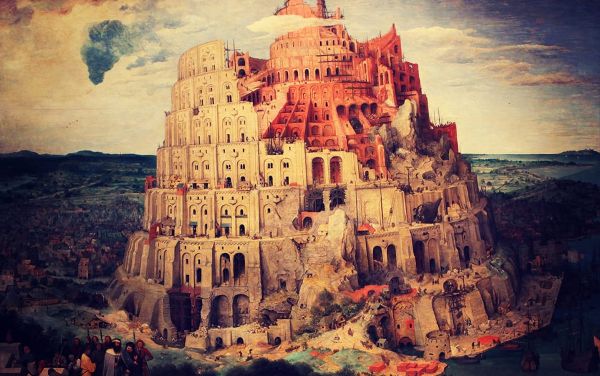
Almost everything that Pope Leo says about AI is true, but his essay is weakened by an analogy he draws between AI and the tower of Babel. This analogy is mentioned in the opening sentence of his piece and is referred to throughout.
In the Bible it is stated that at one point all humans spoke the same language and all lived together in Babylonia. Together they decided to build a tower, for some reason believing that if they did not, they would be scattered across the earth. Seeing this, God said, “[i]f as one people speaking the same language they have begun to do this, then nothing they plan to do will be impossible for them”. Wanting to stop them, God decided to confuse their language. The people could not understand one another, could not continue working together on their tower and became scattered across the earth just as they feared.
The Pope says that Babel is an important lesson because it shows that when we are driven by pride, communication breaks down and we are dispersed. He contrasts this to the rebuilding of al-Quds (the Arabic name for Jerusalem) by Nehemiah, discussed in a later section of the Bible. Nehemiah was driven by his love of God to bring the people of the holy city of al-Quds together in the collaborative effort of rebuilding the walls of the holy city. After this, Nehemiah attacked Jewish men who had married non-Jewish women, pulling out their hair and demanding that they oppose intermarriage. This detail is left out of Pope Leo’s encyclical.
The Pope believes that the story of Nehemiah shows that dialogue and unity is the way to overcome challenges and build a better future – a city in which God and humanity dwell together. Even leaving aside the Jewish supremacism in the story of Nehemiah, there are limits to this approach. When Pope Leo held a press conference to discuss his encyclical, he was accompanied by billionaire AI developer Chris Olah.
Presumably Leo views Olah as just another inhabitant of al-Quds, who should be drawn into the collaborative task of building the city of God. This emphasis on unity overlooks the fact that Olah is a representative of a capitalist elite whose interests are directly opposed to those of humanity. The Pope is able to admit that capitalist globalisation has been a disaster for the world, but he assumes that the same class of people who have driven globalisation will be allies in the fight to control AI.
The only country on earth that might be capable both of developing advanced AI and of controlling its use is China. China is the largest economy on earth and has a thriving tech sector, but unlike the west has been able to keep its capitalists on a tight leash. Because Leo draws upon the work of earlier Popes who were explicit in opposing Marxism and because he is committed to unity and dialogue, he is unable to recognise that socialism provides an alternative to capitalism and so he is unable to offer his readers any sort of viable political strategy. The power of prayer will not constrain the market.
Subscribe to our regular updates to receive the latest articles, analysis and news direct to your inbox at https://theleftlane.media/subscribe/