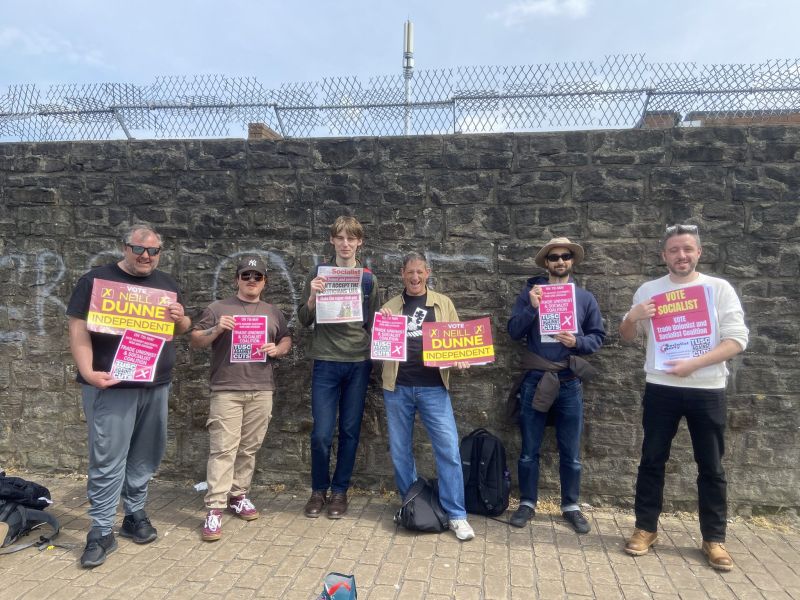
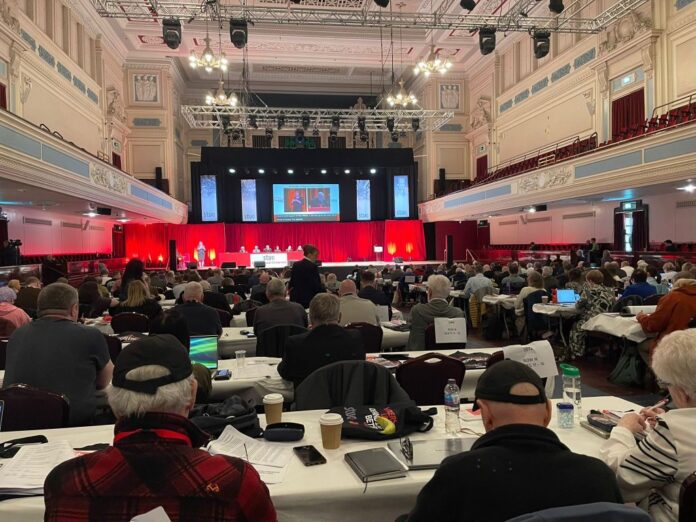
At the Scottish Trades Union Congress (STUC), as every year, most motions elicited no opposition. Much as some criticise this ‘non-debate’ as a futile echo chamber, it is important to keep raising new issues (a favourite this year, and in recent times, has been to highlight the varied impacts of AI) and to formally establish unity in the workers’ movement even where it already exists.
One notable counterexample this year, as the STUC met for its annual gathering in Dundee from 20-22 April 2026, was composite motion G on military spending, condemning the Labour government’s massive hike in ‘defence’ expenditure. Composited from motions independently submitted by Glasgow and Aberdeen Trades Union Councils, this drew the disappointing – but unsurprising – ire of arms industry unions Unite and GMB.
As I noted in my speech seconding the motion, the arms industry exists only to destroy human life and the products of human labour. In Britain, as in all other Western countries, such destruction will never be in the interests of the working class, but in the interests of international capital. That makes it practically the textbook definition of socially unproductive labour and it is in the interest of our class to oppose the very existence of this industry.
Why, then, was there not unanimous agreement?
The beleaguered British working class is right to worry about transitions. The botched and unjust transition from coal beginning in the 1980s is now being followed by an equally botched and unjust transition from North Sea oil and gas, which as an Aberdonian I am all too aware of.
In the oil and gas sector, Unite’s demand is to approve new drilling until job security is guaranteed for sector workers and the communities impacted. Within that context, this makes sense. New drilling doesn’t take away resources from alternate, more ‘worthwhile’ sectors, nor does it itself cause climate change. In the language of classical economics, oil and gas and their derivative products are “demand-inelastic”. Whether more is extracted or less has little impact on consumption, which is what contributes to climate change.
Even if we assume the same of arms, that the UK government is simply building a ‘fortress Britain’ with no intention of using its newly expanded arsenal to wage or support imperialist wars (aye, right), they will still be used in exercises and testing where they will contribute to carbon emissions. They will also be sold abroad for profit and given the history of UK arms exports, likely to be used by genocidal despots and other assorted villains.
All that aside, there is the opportunity cost. The billions being squandered on toys that go ‘boom’ to make our seemingly chronically under-endowed political class feel important could instead be invested in our NHS, our welfare state and our local public services. These sectors are facing massive cuts as it is, and are sectors in which Unite and GMB are also present.
That really is the crux of the perversion. The motion wasn’t even about abolishing the UK arms industry, it simply condemned shovelling even more taxpayer money into it. No jobs are at risk. Public services meanwhile are already facing massive cuts and yet Unite and GMB are swooning over a senseless slush fund for arms industry employers while other jobs are at risk. Some solidarity, eh?
The motion passed on a card vote 625 to 512, demonstrating the collective wisdom of affiliates and proving the socialist case for One Big Union. The narrow, self-interested arguments of the likes of Unite and GMB place them at odds with the interests of the working class and as such actively undermine the class consciousness we ought to be building. Of course, current arms industry workers deserve a livelihood, as all workers do. But that livelihood should come by way of socially productive employment, not destructive service at the hands of the imperial war machine. Demanding more of these jobs rather than more productive jobs is utterly misguided.
At the very least, the congress decision vindicates the crucial role the Scottish Trades Union Congress plays in the workers’ movement. Solidarity demands that our movement speaks with one voice and does not place ‘jobs-for-jobs’-sake’ ahead of our class-based opposition to war. A “good job” is not merely one with good pay and good conditions, but one which produces things we workers can rightly be proud rather than ashamed of.