

The period we live in today, marked by inequality, was formed by the defeat of the organised working class in the west and the collapse of the USSR in the east. In a sense it was the end of history, namely a 40-year history of social democracy based on redistributive politics that followed the end of the second world war. In hindsight, it was this four-decade golden era of social democracy that was the aberration when measured against four centuries of capitalism and the unfettered enrichment of the capitalist class.
Since the 1980s, inequality has grown, proving the maxim that the capitalists will take what they can get away with unless they are prevented from doing so by workers. Some commentators have opined that wealth inequality has reached Victorian standards. This is a difficult comparison to make because home ownership is more widely distributed, a substantial asset, compared to Victorian times when the vast majority of the population lived in rented accommodation.
Income measures are more accurate. In 1875 the average labour income as a share of total income in Britain stood at just under 50% compared to 54% today, so not too dissimilar. However, one metric says it all and that is the rising gap between the pay of directors and their workers. CEO pay depending on the size of the corporation can rise to 300 times median workers’ pay in the USA and between 52 and 112 in the UK. For ordinary directors that stood at 100 to 200 times in the USA and 17 to 37 times in the UK.
More revealing has been the increase since 1965, when the average CEO of a top US corporation earned about 21 times the compensation of the typical worker. That ratio, while still substantial, reflected an era when corporate leadership and workforce pay were more closely aligned. Fast forward nearly six decades, and the story is starkly different. By 2024, CEOs earned 281 times more than their employees. This substantiates, with the charm of sarcasm, the old socialist maxim that competition at the top drives up wages while at the bottom it drives down wages.

Having vented our hot outrage about the disparity on the income side, let us move to the consumption side and take a cooler look at the unhealthy consequences of this inequality. The starting point begins with US president Obama tasking his council of economic advisers to collect tax data on a proposed federal sales tax mimicking VAT in European countries. What was uncovered for the first time was the extent of the inequality in the USA. They found that the top 10% of income earners would contribute as much sales tax as the bottom 80% because they consumed on average eight times as much. More recent figures put the top 10% consuming as much as the bottom 90% as inequality has grown.
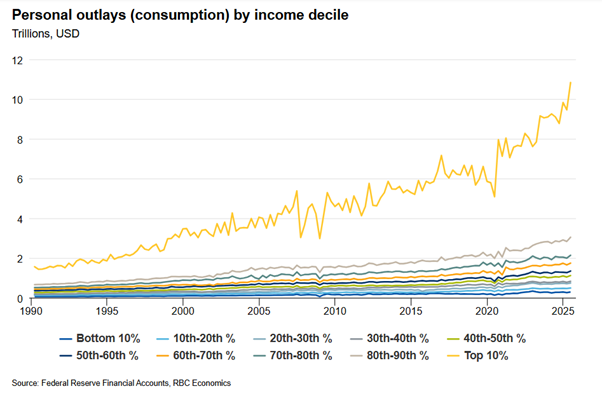
In other words, the top 10% are responsible for half of personal consumption, hence the title of this article. To match the spending of the top 10%, anyone in the bottom 90% on average would have to spend nine times as much of their income on consumption. Thus, personal consumption is highly dependent on the top 10% spending habits.
GDP growth in the USA this decade has been driven by personal consumption growth, most of it coming from the spending by the top 10% of income earners. As the graph below shows, spending by the top 10% in the ten years up to Q2 2025 rose 83% in nominal terms compared to 59% by the bottom 90%. During this period the PCE (personal consumption expenditures) inflation added up to 30% meaning that on average the top 10% provided two thirds of the growth in real personal consumption over this period.
There is one factor which drives the propensity to consume by the top 10% and that is capital gains made in the markets particularly the stock market or bourse. (The top 10% of income earners own over 93% of all listed shares.) According to this Harvard study and others, about 8% of capital gains are converted into spending by investors and speculators annually. That may not sound much in an economy measured at nearly $30 trillion, until we examine the scale of these gains. Measured by the Wilshire 5000 encompassing most of the listed shares in the USA imarket cap rose by $11.1 trillion over the course of 2025 to $68.55 trillion. Multiplying this by 8% yields a spending gain of $888, or when removing foreign ownership to $710bn, which is the minimum not maximum figure, as capital gains are found elsewhere in the fictitious markets, for example the bond market. Nevertheless, this figure is equivalent to 64% of the gain in consumption over the course of 2025 and explains the much lauded ‘resilience’ of the US economy. It also accounted for half the of the nominal GDP growth that year.
But this concentration is a double-edged sword. If the economy is highly dependent on spending by the top 10% of income earners, then it is also vulnerable when stock prices and other fictitious prices fall. When investors and speculators realise they are getting poorer, they pull back as they did in 2009, in a manner different to those who are not beholden to capital gains. Thus, it is not only a question of consumption being narrowly based, but on the triggers that cause retrenchment in spending.
In a future article, Brian Green will look at the AI bubble and what its collapse could mean for an over-indebted economy addicted to AI spending.