
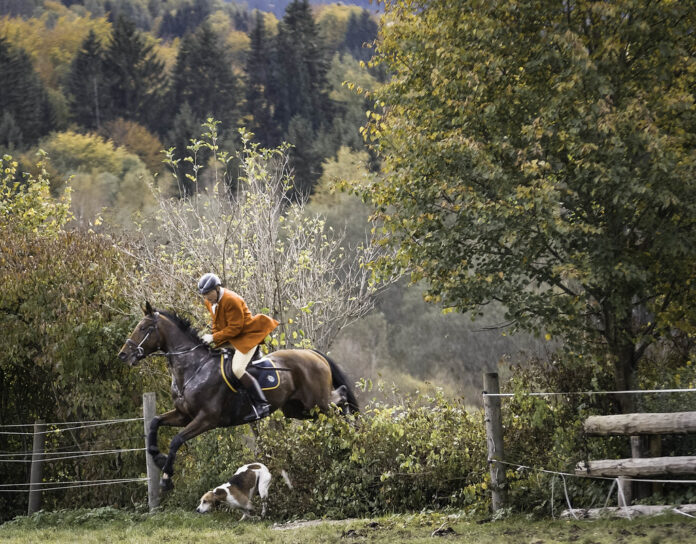
On a hill overlooking a rather idyllic North Yorkshire valley, three friends and I sit and listen to the sounds of a foxhunt. The hounds are in cry – emitting the horrific high-pitched screams that indicate they have scented a fox – but as they are hidden within the large woodland in front of us there’s nothing we can do. Rushing in would be just as likely to frighten any foxes towards the hounds as it would be to do anything else.
After a few minutes of intensifying noise, a fox breaks, fast out of the woods. Stumbling down the hill we fumble through pockets for bottles of citronella oil. We plan to spray it over the ground the fox has just covered. Judging the exact location of a scent-line is harder for four humans than for a pack of 30 hounds, but we appear to have succeeded in finding our mark. As the hounds tumble out of the woods, they reach our position, then fall silent, milling around aimlessly.
We’ve bought the fox a few extra seconds, but, on this occasion, it isn’t enough. The huntsman arrives on horseback and, evidently sighting the fox on the horizon, encourages the hounds to go after it with bright blasts of his horn. We try to follow but are quickly exhausted. As the hounds loop to another wood, their cries reach a crescendo… and the huntsman blows his horn to indicate a kill.
For the last nine years I have been attending foxhunts as a hunt saboteur and for the last four I have been writing a PhD about the saboteur movement. These are two facts that surprise some people, who are under the impression that there are no hunts left to sabotage.
While The Hunting Act, which came into law over 20 years ago, forbade the hunting of wild mammals with dogs, enforcement of the law has always been fraught with difficulty. The Labour Party have finally woken up to this fact and have recently opened a public consultation – running until June 2026 – into the possibility of amending the act to provide a more comprehensive ban.
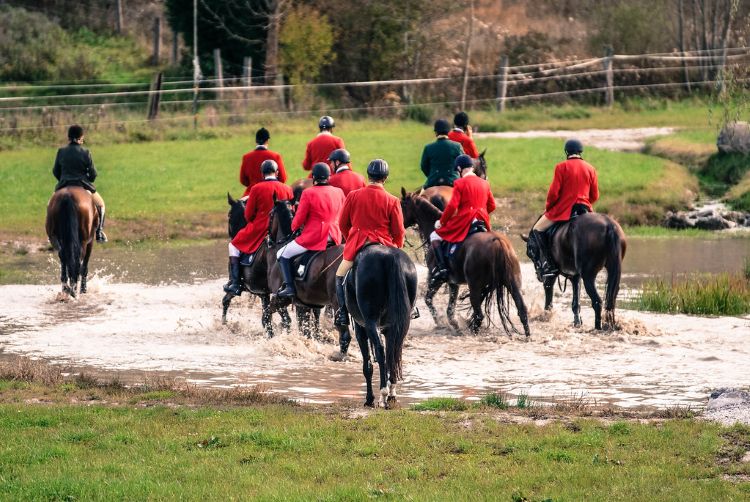
The problems with the law were obvious from the outset. In November 2003, after the act had already been approved by parliament, over 37,000 supporters of – and participants in – foxhunting, signed a pledge to disobey the law and continue hunting as usual. In a 2005 Spectator article in which Boris Johnson talked of his “semi-sexual love of foxhunting,” he said he hoped hunts would “have the courage and the organisation to keep going forever,” but noted that “if the hounds pick up a fox… how will the poor cops prove mens rea?” (the intent to commit a crime).
Trail hunting was inaugurated
This last point is crucial. While The Hunting Act banned foxhunting, it inaugurated the practice of trail hunting, which simulates traditional fox hunting but replaces the fox with a pre-laid scent trail. Theoretically a bloodless alternative to the real deal, trail hunting has the benefit of looking identical to the real thing. Indeed, if one was to lay a scent trail through the British countryside and encourage 30 dogs to follow it, it would seem highly likely that those dogs would ‘accidentally’ find and chase a fox instead. So even the death of an animal is not proof of intentional fox hunting.
To date, these ambiguities have allowed hunts to evade prosecution with near impunity. It is no wonder that Tony Blair, the supposed architect of the hunting ban, congratulated himself on the “masterly British compromise” whereby hunting “is banned and not quite banned at the same time”.
The political debate around hunting is generally understood as a class issue. Hunting is stereotypically an upper-class activity, associated by many with aristocratic privilege and cruelty. At the time of the Hunting Act, George Monbiot argued that “[a]s an animal welfare issue, fox hunting comes in at about number 155… [b]ut as a class issue, it ranks behind private schooling at number two”.
The class analysis of foxhunting also risks overly simplifying matters. Foxhunting is a much more inclusive activity than many people assume. In my years attending hunts, I’ve met more working-class hunt supporters than I have met members of the landed gentry and in some areas Irish travellers form an important part of hunting communities. Unlike traditional working-class bloodsports, such as bear baiting and dog fighting, foxhunting has always involved a great deal of deference towards wealthy patrons, who, in turn have shielded the sport politically from public opposition. In large part, this is why dog fighting and bear baiting were outlawed by 19th century reformers, keen to protect the lower classes from the harmful moral influence of animal cruelty, while the more gentlemanly sport of foxhunting remains widely practised to this day.
The upper classes still provide cover
The cover that the upper classes still provide for foxhunting was dramatically exposed by the Hunt Saboteurs Association in 2020, when they managed to infiltrate a series of webinars organised by foxhunting’s national body – then called The Hunting Office – and attended by over 150 hunt masters. Participants heard from a panel that included the former police inspector Phil Davies and the Conservative member of the House of Lords, Benjamin Mancroft, about how to use trial hunting as a ‘smokescreen’ behind which real hunting could be hidden.
The leaking of the contents of the webinars led to one member of the panel, director of the Master of Foxhounds Association, Mark Hankinson, being convicted of having encouraged others to break the law. Although he was later acquitted on appeal, the reputational damage to fox hunting has proven to be massive. Hunts have lost significant land access as many landowners are unwilling to associate with criminal activity. The Labour government under Keir Starmer has moved to strengthen the ban, promising in their 2024 election manifesto to ban trail hunting. While Keir Starmer generally works hard to break all of his promises, early indications are that Labour genuinely will move to strengthen the Hunting Act this parliament.
While foxhunting has survived the last 20 years, the fact that it might struggle to survive the next 20 months owes to many of the same factors that have thus far ensured its survival. Foxhunting is a participation sport, dependent financially on the large fields of riders that pay to follow the hounds, however very few of these riders possess any great desire to see a fox torn apart. In 1983, animal rights activist and author Mike Huskisson estimated on the basis of his undercover infiltration of foxhunting communities that 95% of hunt riders “are only there for the thrill of a cross country gallop”.
Hiding the killing from the more squeamish
These riders were, however, at least aware that foxes would regularly be killed. With the advent of trail hunting, it has become possible to hide the fact that foxes are killed from the more squeamish – and more law abiding – members of one’s own hunt. It is not uncommon to meet hunt riders who genuinely believe that trails are being followed. The conspiratorial nature of post-ban hunting has therefore worked to deprive the hunts of any constituency of people willing or able to defend their actions.
While large sections of the rural population have long been opposed to foxhunting, hundreds of thousands of supporters still turned out for the Countryside Alliance’s ‘Liberty and Livelihood’ march in support of hunting in 2002. This level of support is unthinkable today. During research for my PhD, I spoke to a woman in her late 20s, who is one of the most dedicated hunt saboteurs I have ever met, and who, prior to her involvement in animal rights activism, worked for a fox hunt.
“When I was younger, I worked for a hunt yard” she told me. “At the time I had friends who went out riding with hunts. Their opinion was that no foxes got killed, that was all legal and I genuinely to this day think they believed that. But one time when I was at work the hunt master came back with a pickup truck full of dead foxes in the back, so I handed my notice in there and then”. It is unclear how any social institution can defend itself politically when it must hide its activities from those who participate in them!
Now, 24 years on from the Liberty and Livelihood march and 23 years on from the 37,000-signature petition pledging to disobey the law, it is doubtful that many respondents to the government’s present consultation will argue that their livelihood depends on the continuation of hunting. Nor is it likely that many respondents will admit an interest in preserving their liberty under the smokescreen of trail laying.
More sensible contributions however, from the majority who are opposed to hunting, are welcome to the government consultation. Click here to make a contribution to the consultation.
Subscribe to our regular updates to receive the latest articles, analysis and news direct to your inbox at https://theleftlane.media/subscribe/