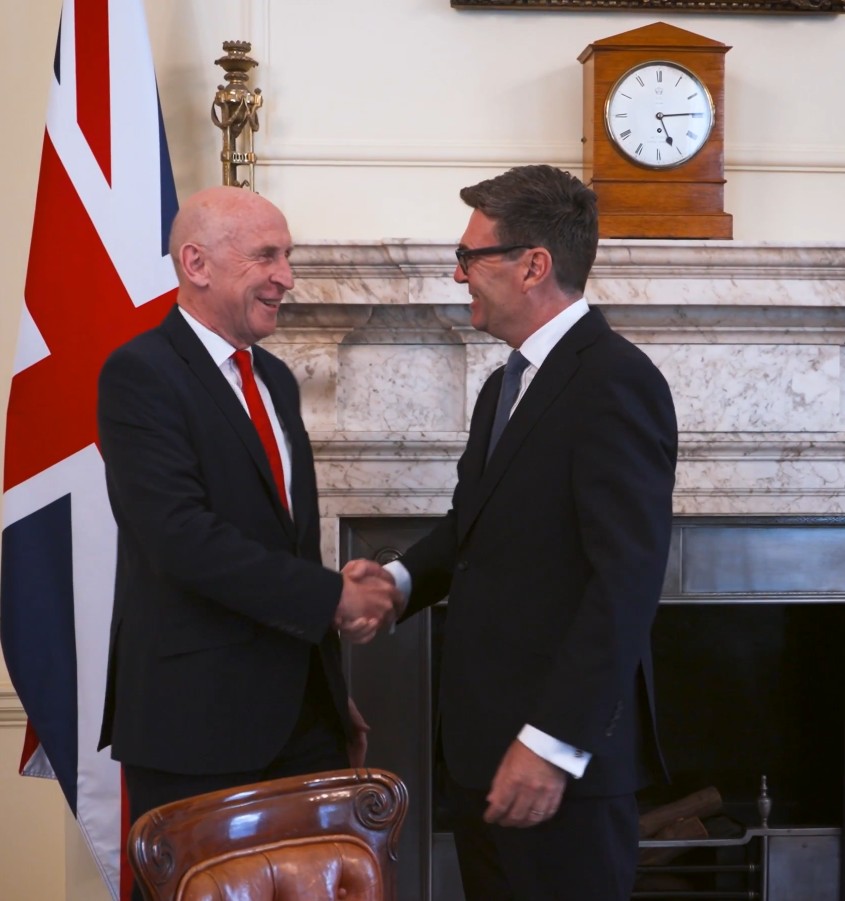
At 28 minutes, Andy Burnham’s acceptance speech for leader of the Labour party covered enough ground to give the appearance of substance without giving too much away. He is yet to become a polished speaker but at least presented as human rather than robot, a step up from his predecessor.
While offering an insincere eulogy for Starmer, Burnham put clear water between them at the end of his speech by saying “I have a plan” – a plan to replace the shambles the Labour government had become under Starmer.
Burnham also has an analysis covering the four decades since Thatcher. This was not just a critique of Thatcherite politics – the 1980s attack on the industrial heartland at the behest of the City of London – but of the globalisation unleashed by George W Bush and Blair in the 1990s, which took wealth and power out of the hands of localities and placed it in the hands of trillionaires and billionaires.
While Burnham did not mention the G word, he did reach for its political consequence. “Take Back Control” had resonance during the Brexit debate precisely because power had been centralised in Westminster and Brussels, as local government was stripped of its powers and finance, while the economy was privatised and wealth distributed upwards as living standards came under attack. The pandemic and the Ukraine war simply reinforced this growing inequality.
Like Major following Thatcherism, Burnham is promising calm after nearly 20 years of turmoil since the 2008 financial crash ended the globalisation era. Rather than reverse Thatcher’s policies after the poll tax riots, Major avoided further confrontation, bedding things in and building a platform for Blair to continue the neoliberal revolution. Blair, as Thatcher said, was her greatest achievement.
So, what is ‘Andy’, as he’ll probably want to be known, going to do? He headlined five things. First, a “one Labour team culture” and an end to “the factionalism that has bedevilled us” – segueing into his second point, to “build a new politics”, since for Labour “this is a last chance to change and we must take it together”.
Clarity on where Labour stands and an end to out-Reforming Reform
He offered to find “common ground with other parties” through “a less toxic political culture” – echoing the “kinder, gentler nation” offered by George Bush in his 1988 convention speech, after eight years of war-mongering Reaganomics. His third point mainly reiterated the attack on Starmer – to “offer clarity on where we stand”, clarity that had been missing for the average Labour voter offered little more than the word “Change” ahead of the 2024 election.
Suggesting that Labour will not try to out-Green the Greens or out-Reform Reform and will no longer “wear Tory clothes”, Burnham repositioned the party on traditional Labour ground by being “distinctively Labour” something Starmer neither had the wit nor the will to express, however vacuous the phrase.
Reinforcing this return to traditional Labourism, Burnham said: “Make no mistake everybody, I will be a pro-business leader of the Labour Party.” And there’s the rub. Burnham aims to collaborate with trillionaires and billionaires to raise living standards, as if global capital – amid economic, social and ecological crisis – is waiting to hand the working class a share of its profits. It is almost as if he has no idea how capital and capitalism work. Or maybe ‘Andy’ isn’t being as genuine as he appears.
Burnham’s final two points worked to present him as neither the “King of the North” nor a Westminster insider. His claim is to lead for all – “north, south, east and west”, “Scotland, Wales and Northern Ireland” – promising to “take power back from Westminster and Whitehall and give it to the place where you live”.
Andy confidently declared: “Today is the most significant change moment in our politics for 40 years.” But what did the speech add up to? A regathering of the social democratic Labourist clan after the traumas of Corbynism and Starmerism. An acknowledgement that millions had lost confidence in a party that won only 28% of the vote in 2024. An understanding that Labour is dying on its feet and at the last-chance saloon. A dose of meaningless political decentralisation, a favourite of British centrists, combined with an alliance with ‘business’ to address some of the “wrong turns” of the last four decades.
Rather than the technocratic robotics of Starmer and Reeves, ‘Andy’ will put a human face on a pro-business alliance. Don’t hold your breath for anything more radical – as Liz Truss found out to her cost, the dictatorship of the financial markets won’t allow it, from the right or the social democratic centre.
Subscribe to our regular updates to receive the latest articles, analysis and news direct to your inbox at https://theleftlane.media/subscribe/