Many on the left are understandably jaded with Westminster politics or start from the position that it’s incidental to truly transformative social and political change, which should begin at the grassroots of workforce and community organisation. I imagine The Left Lane readers have at least some sympathy with that view.
This is partly because it’s much easier for the right to remake the state in its own image through elections, since the changes it seeks are often either an undoing of progressive gains or built on the dominant ‘common sense’ already embedded in capitalism’s bureaucracy, media and hierarchies. It’s easier to destroy than to create, easier to reinforce than to innovate – particularly when the tools being used are those bequeathed by the existing rulers.
Since 1979, there’s no real argument that the most radical changes in the UK have been driven by the right. Thatcher’s governments began this, on the back of political strategies that, even when not dominant at the time, paved the way for Brexit, Boris Johnson, Liz Truss and Nigel Farage.
That should give us pause when considering the modern far right, which now stretches from the larger part of the Conservative party to Reform, Restore Britain and the not-so-fringe lunatics around Stephen Yaxley-Lennon. A Reform or Reform-led government would be disastrous – legally, socially, and economically (Farage has named Truss’s first budget his favourite) – making the job of rebuilding even harder.
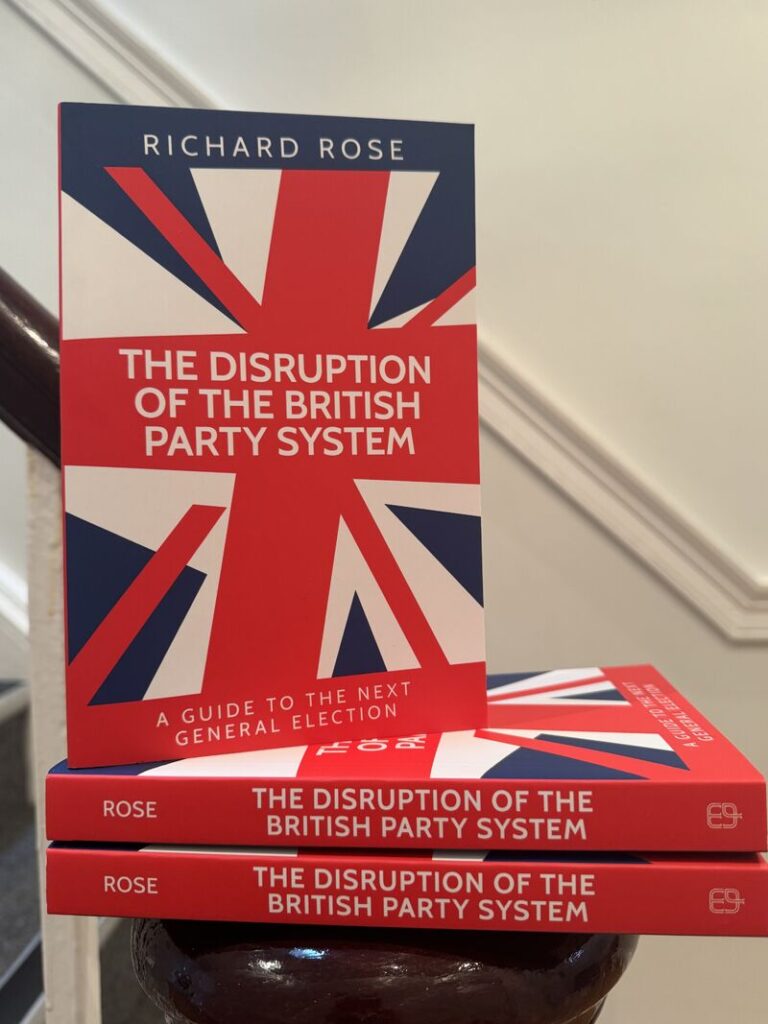
How likely is that, though? Predicting UK election results has become notoriously difficult amid unprecedented political flux. Richard Rose is fairly described as the doyen of British political science, with a career stretching back to the 1950s studying UK elections and comparative political systems, and some readers may know him as a commentator on past BBC election night coverage. In his latest book, The Disruption of the British Party System: A Guide to the Next General Election – written for a general readership – Rose surveys the state of the parties likely to shape the next election and, in his final chapter, sketches out scenarios for the post-August 2029 government.
Some readers may feel these predictions have already been overtaken by events – Andy Burnham’s imminent ascension to the Labour leadership and premiership and Farage’s snap resignation to escape the smell of dodgy-donation accusations. But that would be unfair to Rose, who is too circumspect to bet on a particular outcome and there’s plenty in his analysis that anyone sizing up their chances in the next election – Burnham included – would do well to note.
The author writes in admirably plain English, free of academic jargon
Rose, born in America and still unable to vote in UK elections, may feel this gives him a kind of objectivity and he writes with a studied, largely atheoretical neutrality. Readers unfamiliar with political science as a discipline may find his potted histories of Labour, the Conservatives and the rest across 70 years of elections a little thin.
There’s no radical social theory here, no ideas of social or cultural struggle, no attention to the dominant fractions of capital. The word ‘neoliberalism’ doesn’t appear once (if that’s the kind of analysis you want, I’d recommend John Clarke’s excellent The Battle for Britain: Crises, Conflict and the Conjuncture). Rose writes in admirably plain English, free of academic jargon, but firmly within the mainstream tradition of political science – a mainstream he’s done much to shape in this country.
In that framework, elections are part of “political systems” – legal and constitutional in nature –giving rise to party systems with similarly rule-based foundations. Parties compete, using policy to advance certain interests and win over voters whose party identification is weak and liable to shift.
To the outsider, some of this can sound like facile truism, a point Rose himself wryly acknowledges via a nice anecdote about a debate with Tony Crosland over the role of class in voting patterns. The effect, though, is that to an already well-informed reader, the book’s first section can read like an A-level primer on recent British political history.
Rose had a point in that argument with Crosland, but it didn’t make him right. He treats sociologists as presenting class as a simple determinant of voting behaviour and he’s correct that even in 1950s Britain – with its relatively settled, monocultural, heteronormative self-image – this wasn’t the case. But sociology has long understood class as relational, mediated by, and refracted through, race, gender, work and social institutions like the family, without that meaning class leaves no fingerprint on any of them. It’s a straw man.
In this systems-based view, the voter – especially what Rose calls the “open minded voter” (a term he never quite defines, though he distinguishes it from the media’s patronising “floating voter”) – is a rational actor choosing a party based on competence, values and the issues of the moment. Voters change allegiance over a lifetime, he argues, not out of indecision or caprice but in response to government and opposition performance. Looking for reasons behind the collapse of the old Labour–Conservative model, and the more recent Labour–Lib Dem–Conservative one, Rose can’t point to underlying socio-economic trends or the contradictions of patriarchal capitalism.
The growth of the “open-minded” voter
Instead, he notes the growth in “open minded” voters as old party loyalties weakened, as Labour and the Conservatives radically remade themselves under Blair and Thatcher, as new parties proliferated, as issues like immigration rose to prominence and as trust in politicians generally eroded. There’s no acknowledgment that this mistakes symptoms for causes – though you can’t blame Rose for not doing what he never set out to do or lay the limitations of a whole discipline at his door.
The book’s second and third parts turn more interestingly to the current state of the parties and the prognosis for 2029. Rose rightly focuses on the voting system itself and how it skews the distribution of seats relative to vote share. He’s clear – and well justified – in believing it was largely this system, and the shedding of Conservative votes to Reform, that handed Labour government, rather than any intrinsic quality of its policies or leadership. He’s equally clear on the indecision, incompetence and U-turns that have since left Starmer in the unusual position of a Labour leader ousted while in power and offers useful statistics on how various parties’ 2029 strategies might fare.
Notably, only a sixth of Reform voters are currently likely to switch, and of those, a vanishingly small 4% would go to Labour – suggesting Starmer’s pursuit of that vote was always doomed. But the voting system itself could still hand Reform significant power. They’d need roughly 150 seats from Labour for a majority and came second in only 89 of those last time. That statistic could work in Burnham’s favour.
Rose also pays welcome attention to parties long dismissed as minor at Westminster – the Greens and those representing Scotland, Wales and Northern Ireland. He suggests the SNP could recover lost ground and that the Greens and Plaid Cymru might both increase their MP counts. One effect of the old system’s disruption, in other words, is a much stronger incentive toward tactical voting and coalition politics – on the right as much as the centre and left.
A crowded field – Conservative, Reform and now Restore Britain – is chasing the same right-wing voters, while Labour, Lib Dem, Green, SNP and Plaid all compete for the less reactionary vote, if not in quite the same places. Tactical voting is something the “open minded” voter has already shown a willingness to do in byelections – Gorton and Denton, Makerfield – though traditionally that’s been more likely when the stakes are lower and no government hangs in the balance.
Coalition politics and popular fronts could push voters further in that direction or simply remove the choice altogether. Whether that shifts current party positions is another matter. A Conservative-Reform pact might make sense for both Farage and Badenoch, but Rose thinks it unlikely given their past statements.
He leaves us instead with what some might see as the inevitable endpoint of all this – hung parliaments and a moment where the only way through the deadlock is for the old guard to concede and usher in a system built on proportional representation. Burnham may pre-empt this and back PR anyway, though it’s hard to be confident either way.
In the meantime, the best way to slow Reform’s progress might simply be to get the vote out for Count Binface.
The Disruption of the British Party System: A Guide to the Next General Election by Richard Rose is published by Manchester University Press, price £20.