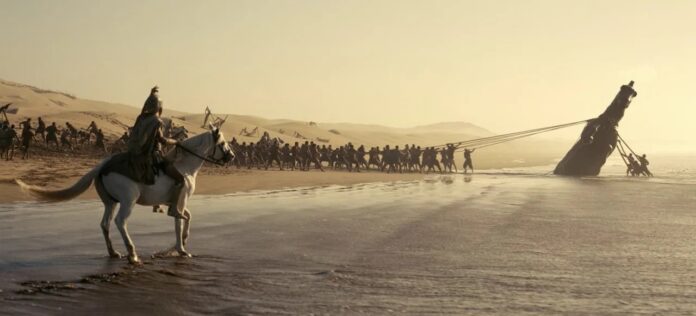
Christopher Nolan’s new film The Odyssey is, perhaps more than any film he has made so far, a masterpiece. An adaptation of Homer’s epic, it stars an ensemble cast including Matt Damon, Tom Holland, Anne Hathaway, Robert Pattinson, Lupita Nyong’o, Samantha Morton, Zendaya and Charlize Theron.
Nolan takes one of the grandest myths in the western canon and with the help of a 60-foot animatronic cyclops, an eye-watering CGI budget and one of the most star-studded casts ever assembled, makes it even grander. Anyone who hasn’t seen it yet should, while it’s still in cinemas.
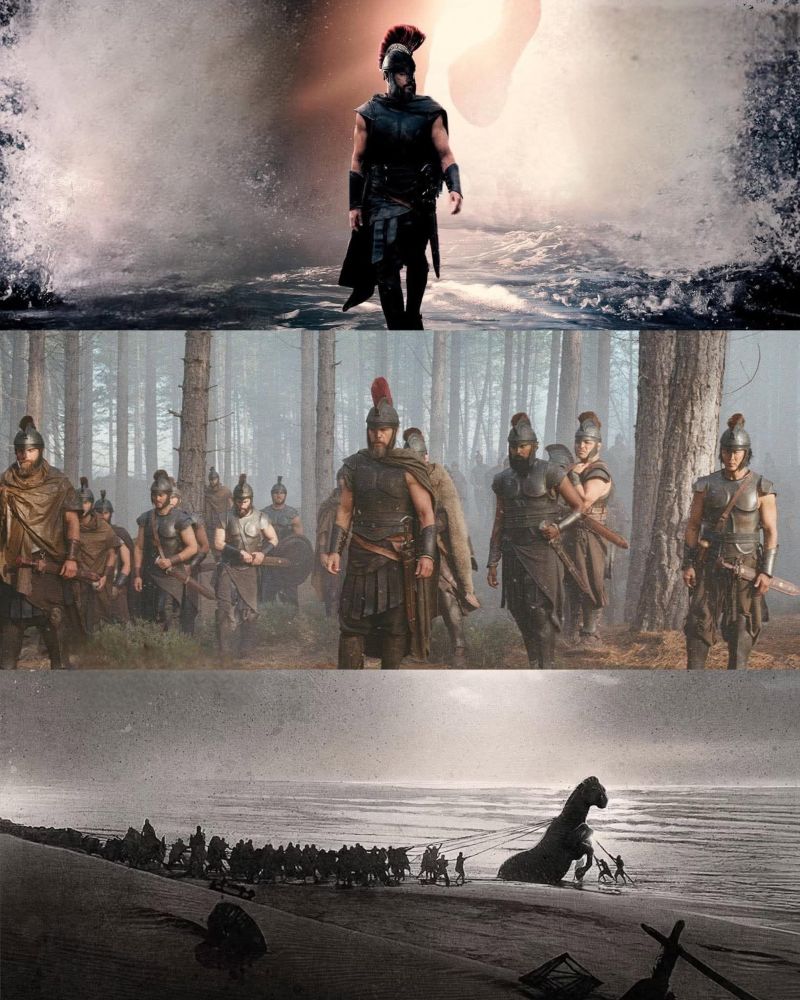
Odysseus (Damon), the Greek king of Ithaca, undergoes a long and perilous journey home after the Trojan War, encountering mythical beings as he tries to reunite with his wife Penelope (Hathaway). The film has attracted criticism for historical accuracy – the Greek soldiers’ costumes look nothing like genuine Bronze Age armour and bear a passing resemblance to the batsuit from Nolan’s Batman trilogy. More controversially, none of the actors are Greek and none of them were alive in the 12th century BC. Lupita Nyong’o’s character, Helen, was famously hatched from an egg fathered by a swan.
Despite these liberties, Nolan has also reshaped elements of the story to fit the known history of the Bronze Age. In doing so, he puts the story on firmer footing – but he also reproduces a ruling-class understanding of history, one that ignores the role the masses play in shaping society.
Greek tragedy, American farce
One of Nolan’s better changes comes early, when Odysseus tells Penelope that the pretext for the Trojan War – recovering Menelaus’s eloped wife Helen – is simply a convenient excuse. The real architect is Agamemnon, who wants to crush Troy as an economic rival and monopolise Aegean trade.
This makes the ten-year siege more believable and could not be more timely. The Odyssey came out the same weekend America resumed strikes on Iran – a war once justified as liberating women, now admitted by everyone to be about suppressing a regional rival to American power. Iran’s leverage flows from its control of the Hormuz strait; Troy sat on the Dardanelles, where the Gallipoli peninsula limits access to the Black Sea. The Iran war has so far lasted only months, but the possibility of a Troy-length quagmire isn’t out of the question.
With the war’s motive reimagined, Nolan reassesses its spiritual stakes too. One of Homer’s enduring themes is ‘Xenia’ or ‘guest-friendship’: Paris broke it by eloping with his host’s wife, and Troy’s destruction was framed as enforcing that principle. In Nolan’s film, Xenia (rendered as “Zeus’ Law”) is invoked constantly – but it plainly doesn’t justify an imperial war. Instead, Odysseus comes to realise that entering Troy under false pretences, hidden in a wooden horse, made him the worst possible guest. In massacring Troy’s people, he didn’t just break Xenia – he may have destroyed it forever.
Sea People
Throughout the film, characters warn of the “Sea People” who might destroy the Greek city-states. When Odysseus and his men rob villages along the Anatolian coast, the terrified villagers ask if they are the Sea People. “No,” comes the reply. “We are Greeks from Ithaka.”
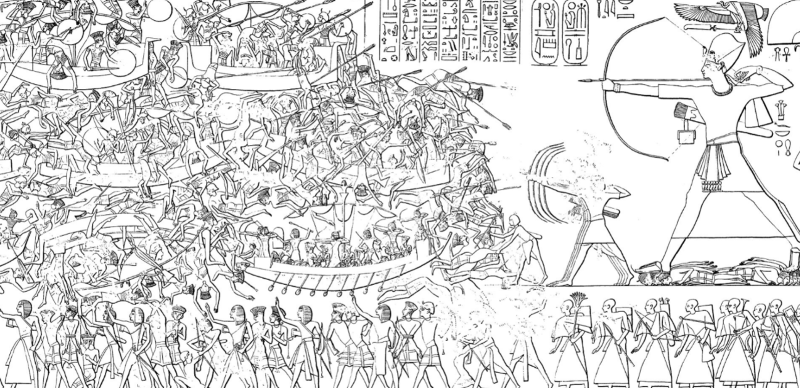
The Sea People don’t appear in Homer, but they were real. Egyptian sources record several waves of attack, including the Peleset (origin of the word Palestine) and the Ekweshn – likely the Egyptian rendering of Achaean, Homer’s own name for the Greeks.
By the film’s end, Odysseus admits to Penelope that he is one of the Sea People – that in breaking Xenia at Troy, the Greeks destroyed the moral law underpinning Mediterranean civilisation. Nolan’s Odysseus takes responsibility for the Sea People’s wider violence, suggesting they only do what they do because he rendered guest-friendship meaningless.
Bronze Age collapse?
The Sea People are often cited as a key cause of the Bronze Age Collapse. Around this time, the Hittite empire disintegrated, Egypt and Assyria lost territory and interstate trade collapsed – cutting off the tin supply needed for bronze.
Nolan’s film ends with Odysseus predicting the end of “our Age of Bronze” – bittersweet, since he’s reunited with Penelope and seen his son crowned king, but bitter because the era’s end is framed as tragedy. Penelope asks why people will sing about them. Odysseus replies that song is the only way to remember those who could write. By this point the dialogue is getting a little silly, as Nolan rushes to hammer home his themes before the credits roll.
It’s true the Odyssey began as an oral song for centuries before being written down and that writing was lost at the Bronze Age’s end, not to return for 400 years. But the idea of writing as a vehicle for remembering dead heroes would have been alien to an actual Bronze Age Greek – writing then was almost exclusively a bureaucratic tool for tracking taxes. For many people, losing it might have been a good thing.
The Sea People were real, but popular uprisings likely played just as big a role in the end of Bronze Age states. Historians have noted that in many sacked cities, only palaces and temples were destroyed – residential housing was left alone. The theologian Roland Boer has suggested the biblical stories of Sodom, Gomorrah and Babel preserve folk memories of oppressive palaces being torn down.
The Collapse didn’t end society – it ended the palace economy, in which peasants paid heavy taxes to a central authority that redistributed wealth back out. Good system for kings and priests; less good for the people funding it. In many cases, people likely simply chose to decentralise – removing the need for reading and writing along with it.
No more heroes
The Odyssey struggles with this social history because it’s a story about one hero, not about wider social forces. It’s the view from within the palace walls.
The technology matters here. Bronze Age warfare centred on the chariot – expensive, specialist kit that only a warrior caste, or a centralised state like Egypt’s, could field at scale. By the time of the Collapse, mass-produced spearheads (first bronze, then iron) signalled a shift to infantry – cheap, numerous, and far more egalitarian in composition, since success depended on the coordination of the many rather than the heroics of the few. That shift from chariot to spear plausibly explains why popular uprisings against the palace system became thinkable at all – kings were not supermen, but pampered aristocrats who often had good reason to fear the peasants outside the gate.
It would be unreasonable to expect a Hollywood blockbuster to portray Odysseus this way and the heroic register is part of what makes the film so compelling. But it’s worth remembering that Marx was right: all history is the history of class struggle. Enjoying the art shouldn’t blind us to that.
I rate this film five stars, but only one hammer and sickle.
Subscribe to our regular updates to receive the latest articles, analysis and news direct to your inbox at https://theleftlane.media/subscribe/