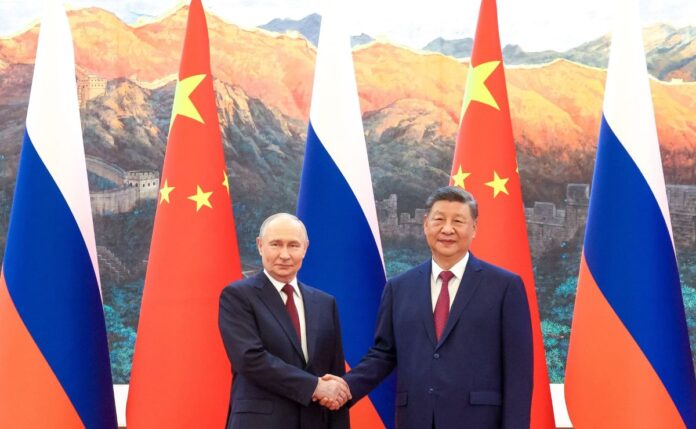
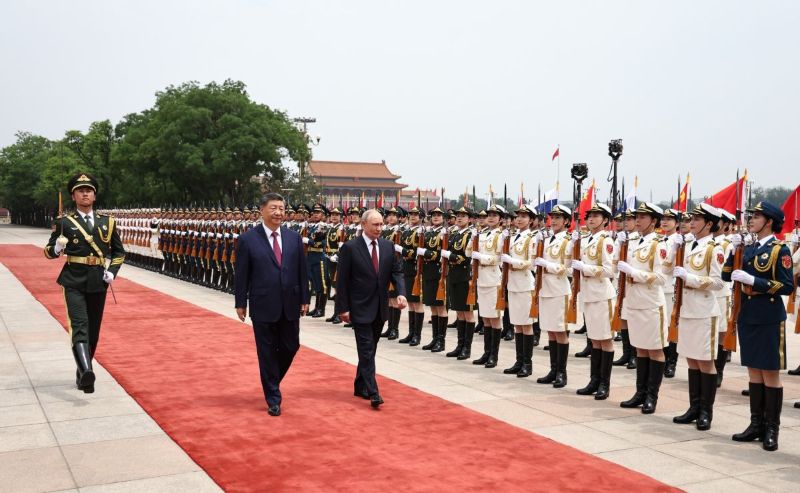
Trump’s visit to Beijing was followed shortly by Putin’s. Both enjoyed pomp and ceremony, or superficial flash. However, the content and results of the two meetings could not be more different. Trump left with nothing, not even the 200 Boeing jet orders which the Chinese have not confirmed nor have any Nvidia H200 chips been ordered. Describing the retinue of billionaires as excess baggage was accurate. Their purpose was to shift the gravity of the summit from the political to the economic, but in the end, Trump did not succeed. He failed both politically and economically.
This is not a personal observation. Much of the media, even in the USA, admitted that it was Xi who strong armed Trump not the other way round. Trump entered the negotiations smarting from the dual defeat in the Ukraine and Iran. Compared to this, his two successes in Syria and Venezuela were in the relegation zone. Trump entered the summit with little leverage and left further weakened.
On the other hand, Putin and Xi signed off on 40 deals. The Russian media praised the outcome. “President Vladimir Putin concluded his state visit to China yesterday (May 20), marking what appears to be one of the most productive, forward-looking, and strategically significant Russia-China summits in recent years,” it said. It was not the number of deals which were so significant, but the quality of the deals.
For the first time, China no longer took into consideration the consequences of US sanctions which before had blocked deals with Russia. This was particularly true for the commercial aviation agreements. After the Ukraine war broke out and the US retaliated with additional economic and financial sanctions, China withdrew from their joint CR929 jetliner programme. This wide-bodied plane was being developed to compete with Boeing’s 787 jetliner and Airbus’s 350 plane. By abandoning this project to secure western components for its narrow-bodied C919 jetliner going into service, China ended up increasing its reliance and dependency on western suppliers rather than Russian.
It appears this has been reversed. Between the two countries they now have the base for indigenous aircraft production including engines. No doubt the success of the locally produced Russian MC-21-310 jetliner powered by Russian engines contributed to China’s newfound confidence in their joint abilities.
It is important to remember how much Chinese decisions are governed by commercial considerations. If they can deal with the west, they compromise. But this can be fraught, as they found out through the delays to the roll out of their own C919 narrow-bodied jetliners due to a deliberate shortage of jet engines from the west. It seems to have dawned on the Chinese that by keeping Russian advanced manufacturing at arm’s length they have not protected but harmed Chinese industry.
China backing for energy companies
Another telling point which occurred outside the summit was the instruction by the Chinese government that refiners and importers of energy were to ignore the threat of US sanctions. The government would have the back of the energy companies and if the US invoked penalties, China would retaliate. This change in policy, as well as the wake-up call from the war in Iran, cleared the ground for finalising the world’s biggest gas pipeline, The Power of Siberia, which will cost over $400bn to construct.
In addition, accompanying the large professional Russian delegation, was the head of Russia’s central bank. Elvira Nabiullina. Her presence symbolised the ever closer financial, trade and auditing alignment between the two countries. Trade is the message. Over the course of the year, US-China trade fell 16.6% while Russo-Chinese trade rose by 19.7%. 99% of their combined trade was conducted in either Yuan or Roubles using their own non-western financial systems for 90% of the transactions.
The growing confidence of the Chinese government is born from growing commercial successes. This is true of the single most invested industry – AI. China has effectively caught up in software including LLMs despite lagging in hardware and it has done so despite the US spending $285.9bn in 2025 versus $12.4bn in China.
But it’s not only in investment where Chinese efficiencies shine, it is also in the cost of usage, a complex task which costs $15 with GPT-5 runs for about $0.50 on DeepSeek. As a result, the popularity of DeepSeek and the QWEN (Alibaba) is soaring particularly outside the US and Europe. The Digital in Asia article above concludes that while the US has won the early sprint, it will be the Chinese who will win the marathon, especially when Chinese EUV lithography machines move into serial production.
What this all means is that the days when China held the quantitative advantage, while the west held the qualitative advantage, are over. Very few technology bottlenecks remain and what remain are only a few years from being overcome.
President Xi’s assertiveness is a strategic move
The new assertive stance of President Xi is a strategic move. Up to now, the imperative guiding Chinese policy was to play for time, time to catch up, to close the technology gap, to build its military capacity. That does not mean the assertive Xi is reckless, he has retained his position calling for a peaceful resolution of both the Iranian and Ukrainian wars, rather than offering unconditional support to either Russia or Iran.
There is another vital reason for Xi’s newfound assertive stance and that has to do with BRICS, the global south and the Gulf region. BRICS is fragile with India aligning itself with Israel for example. By playing to Chinese strength and US weakness, the Chinese government wants to put the heft into multi-polarity. The days of China being the quiet operator manoeuvring behind the scenes seems to be over.
In contrast, the summit in Beijing highlighted US weakness. Post-summit this weakness is increasingly apparent as the negotiations to end the Iran war drag on. Washington’s optimistic stance on the possibilities of resolving the outstanding issues is not mirrored by a cautious Iran. Iran’s missiles give it escalatory dominance because they have the capacity to destroy the entirety of the Gulf infrastructure from subterranean fibre cables to energy and desalination plants. And Teheran has made it clear that should war commence it will not hold back this time.
Below, is Trump’s Saturday evening post on Truth Social. Note his emollient words towards Netanyahu in contrast to their previous call which according to Axios ended in acrimony.
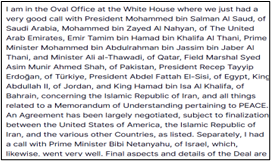
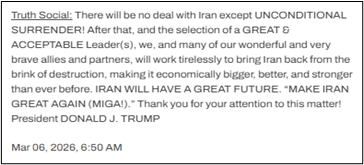
Contrast this to what Trump had to say on 6 March (see below). Then he said he would not negotiate with Iran and called for Iran’s unconditional surrender. Since 6 March, Trump has issued 11 threats to blow Iran from the face of the earth, but without following through. This open-mouthed thinking has invoked the law of diminishing credibility. He is beginning to be taken less seriously which is very dangerous for the reputation for any global leader. It has accelerated the drift to China.
There are reports that Trump was expecting some agreement on the war over the weekend. He even missed his son’s wedding and had prepared the White House press corps for a grand face-saving proclamation. It did not come. In frustration, the US lashed out with a minor attack on Bandar Abbas, an Iranian port, killing four sailors. Not enough to provoke a renewal of the war, but enough to express displeasure at the delayed peace announcement. What happens next depends on Iran’s response.
But all is not lost for the USA. Its grip on the global energy market has tightened. The rise in the oil price, mainly traded in dollars, has increased the demand for dollars strengthening it. While Washington realises the war in Ukraine is lost, they do not consider the economic war outside Ukraine to be lost. Ukraine has been specifically targeting Russian energy facilities seeking to disrupt oil and gas production as well as ports. They have had notable successes. On the high seas, interdiction of Russian vessels remains probable.
What is clear is that the Axis of Change – China, Russia and Iran – is beginning to reshape geopolitics. Last year, for the first time, Xi retaliated economically against US boycotts and embargoes. This year he has gone further by disrespecting US sanctions.
The original cancelled summit in Beijing was timed to follow the swift crushing of Iran. This was meant to strengthen a unipolar world led by Washington. Instead, the setbacks in the Gulf robbed Trump of this opportunity. The opposite has taken place – it has strengthened multi-polarity. And China is at the helm.
Subscribe to our regular updates to receive the latest articles, analysis and news direct to your inbox at https://theleftlane.media/subscribe/