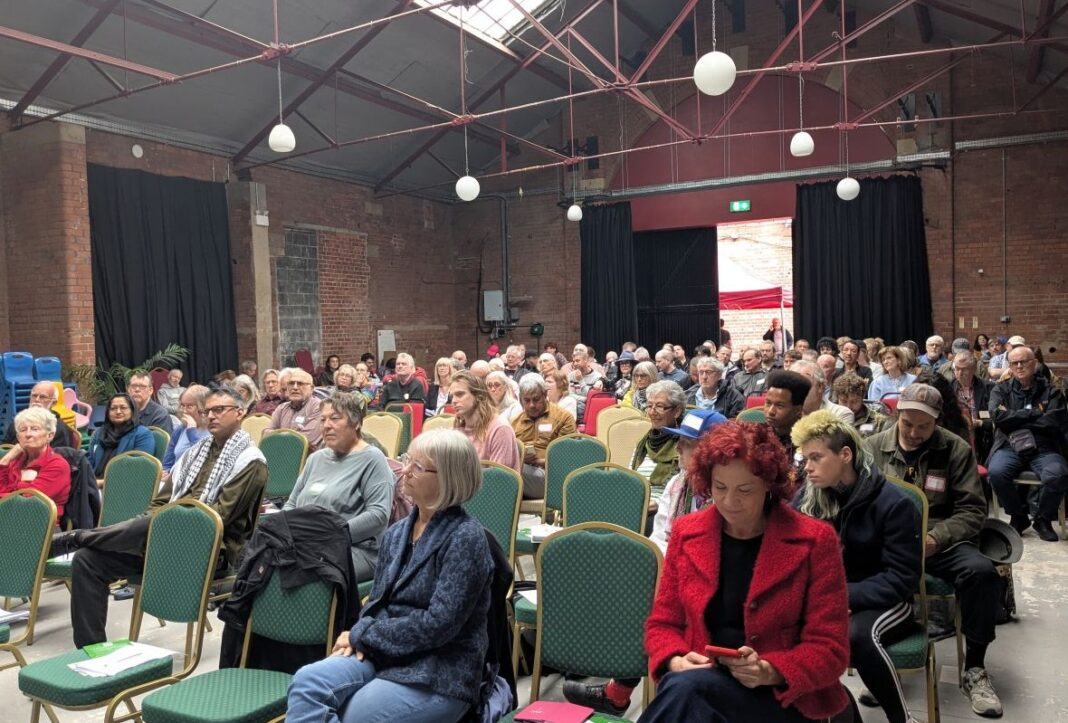
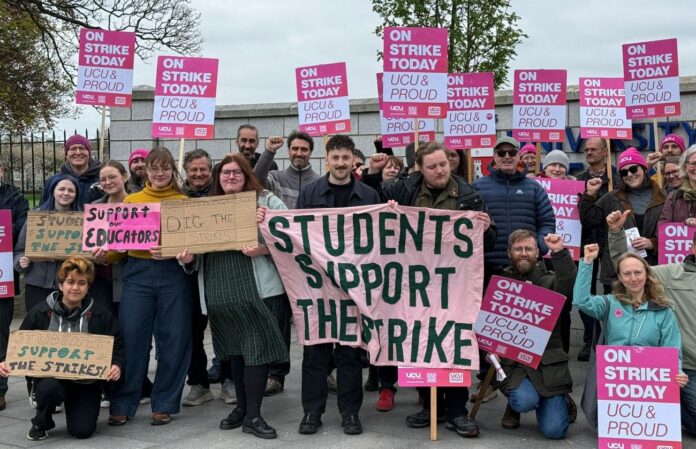
UK higher education is currently undergoing its most significant contraction ever. This has meant job losses on a scale that, if mirrored in more newsworthy parts of the economy like manufacturing, would merit headline features on television news.
The University and College Union (UCU) branch at Queen Mary, University of London, hosts a webpage tracking these job losses. It lists 110 institutions making combined cuts of hundreds of millions of pounds, ranging from voluntary severance packages to large-scale compulsory redundancies (a possible 600 jobs at the University of Nottingham) the closing of departments, schools and courses, ranging from not just cuts in ‘niche’ provision, such as Ancient Languages at Cardiff, but also the more ‘vocational’, such as chemistry at Bangor and numerous health and bioscience related courses, from Birmingham to Queen Mary.
It has even reached those bastions of privilege, the LSE and Cambridge. The UCU has struggled valiantly against this onslaught, with some successes, such as at Newcastle University, where compulsory redundancies were withdrawn in favour of a voluntary severance scheme, but the overall picture is one of ruthlessly semi-managed chaos, with excessively renumerated vice chancellors destroying the livelihoods of families whilst some of them still pocket huge bonuses.
This chaos, however, has resulted directly from government choices, both long term and very recent, such as the cost of pandering to racism by restricting the recruitment of international students. The failure to intervene, despite this being a sector that one would have thought was a likely source of employment for Labour voters, is a result partly of Blair’s positioning of HE as a quasi-market-driven simulacrum of the private sector, allowing it to be seen as self-governing, despite its reliance on public money and a desire not to be seen as pandering to the ‘woke metropolitan elite’ and their children. Students, despite the fact most of them work and study, do not fit the ‘hard working families’ stereotype and neither, it appears, do academics.
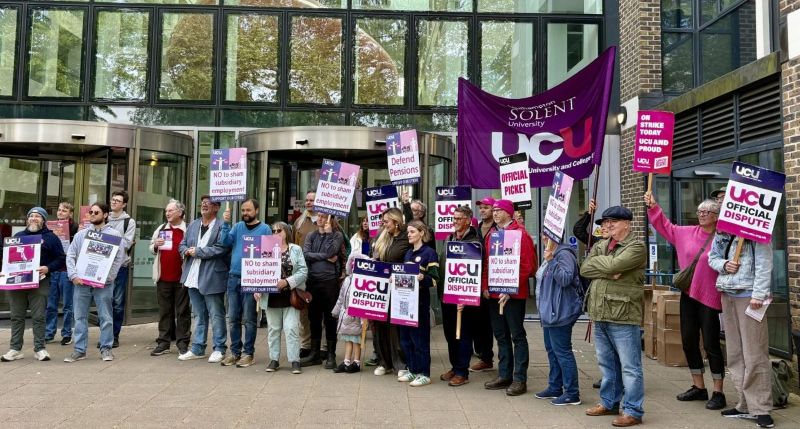
This developing situation has been little covered by most of the media and, it has to be said, largely ignored by the UK left, but it has also been effectively ignored by the Starmer government. Their only real intervention being a minor hike of tuition fees, a very temporary stopgap that did nothing to stabilise the sector. This lack of action was not a surprise, however, as the signs could be read some time ago.
Sonia Sodha in 2024 in the Observer presented an analysis of the problems with the current funding model, an analysis undoubtedly reflected in government circles. It pitted students against universities, with the latter characterised as somewhat unscrupulous businesses aiming to sell shoddy goods to powerless consumers, at least in the case of the non-elite universities.
What was telling about this narrative was the way in which it echoed long-standing tropes of the right. Although shying away from naming which degrees she considered to be typical of the shoddy goods on offer, the basis for her judgment was clearly about the creation, or lack therein, of employment opportunities – essentially widening participation had failed because “we do know that almost a third of graduates do not end up in graduate jobs”.
A neo-liberal model of education that has failed
In other words, the failure of the neo-liberal model was down to the institutions made to model it in civil society, not the model itself or the economic and political thinking that gave rise to it in the first place. Furthermore, the basis for judging education, or at least the education offered to the masses, is not its ability to broaden knowledge and understanding but a simple, transactional notion of value-for-money. Tony Blair’s so-called ‘knowledge economy’ hadn’t failed to materialise for economic reasons, but because universities had failed to live up to the promise.
Philip Augur in The Guardian, at roughly the same time, offered a more detailed discussion of how the government should approach the funding quandary, but it was also one essentially based on the same neo-liberal model of the purpose of HE. Augur, a former banker, was chair of Teresa May’s government review of post-18 education and funding and his recommendations for change in his Guardian piece, although labelled by himself as ‘radical’, were simple extrapolations of this neo-liberal thinking, seeking greater ‘value for money’ and suggesting cost cutting by slimming down the range of provision (getting rid of the ‘poorer performing’) and attacking university support services.
In other words, less choice for the student and less of the lower-paid jobs. It is a strange argument that supposedly champions the ‘consumer’ by suggesting they should have less choice and this contradiction serves to illustrate some of the many logical fallacies embedded in the system. The student was meant to be a rational actor able to choose between a range of providers for a product, their education, based on the knowledge given them by the even-handed ‘metrics’ laid out by university league tables.
The stupidity of this should be fairly obvious to most, given the laughably unreliable methodology of the National Student Survey that collects this ‘data’ and the absurdity of a concept of education as a commodity – try taking back your knowledge and exchanging it for a new set of mental constructs some time! Now it appears that despite this raft of information offered by the Office for Students, the student is no longer able to differentiate between a genuine educational opportunity and a bum steer.
The neo-liberal roots of this thinking are obvious but there are also echoes of populism in its contemporary framing and its outcomes, with liberals essentially blaming one of the supposed bastions of liberal society – the academy – for its own ills. It is also a sign of the times that the current chaos has gone far beyond what establishment ‘thinkers’ were apparently envisaging. The provision that was supposed to fall by the wayside was obviously the marginalised subject areas that weren’t clearly vocational, especially those designed to foster a critical view of society and social relations.
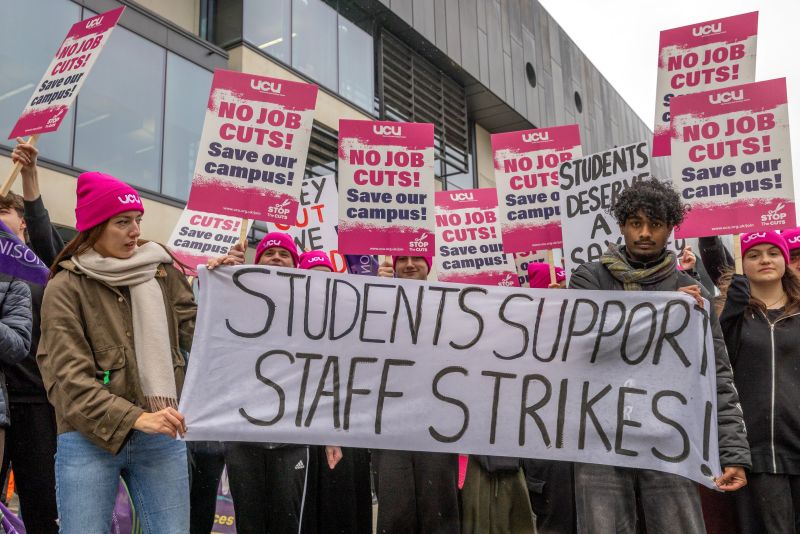
However, as should be obvious from the first paragraph of this piece, the cuts have been much deeper and wider and eaten into what any liberal would probably once have seen as essential provision in the fight for global HE competitiveness. The roots of the current situation may lie in the Blairite funding system that has left young people with unheard of levels of debt and a management model that treats vice chancellors as akin to some kind of Steve Jobs figures, but it has grown to become a sign of how the current ‘polycrisis’ is eating into once stable parts of British society.
Will a Burnham government, or any other ‘soft left’ coalition, resolve this state of affairs? It is difficult to see how this can be done without a truly radical change. Starmer’s farcical attempt at repeating history by refashioning Blair’s knowledge economy as one driven by AI, was almost given a knockout blow in terms of HE when Staffordshire University recently used it as a substitute lecturer! Something that didn’t end well.
What is needed is not simply a revised idea of how to fund HE but a revised idea of its purpose, something new digital technology will not provide. Instead, there needs to be a clear break with the fallacies that education is the driver of national economic success and that its main purpose for the individual is to bridge the gap between school and a job. Students value, especially those from working-class backgrounds, the experience of expanding their intellectual and social horizons and this is something that should be open to all.
Universities can provide this, but they are also an important means by which a society can build up its store of knowledge – knowledge without which the ability to solve future problems, whether they are to do with the environment, health or politics, is severely limited. Leaving education to business and business models is a sure-fire way to shed these socially useful functions and replace them with whatever debased qualification can be sold as a new way to prosperity. A new government should grasp the nettle and radically revise the whole structure.
Subscribe to our regular updates to receive the latest articles, analysis and news direct to your inbox at https://theleftlane.media/subscribe/