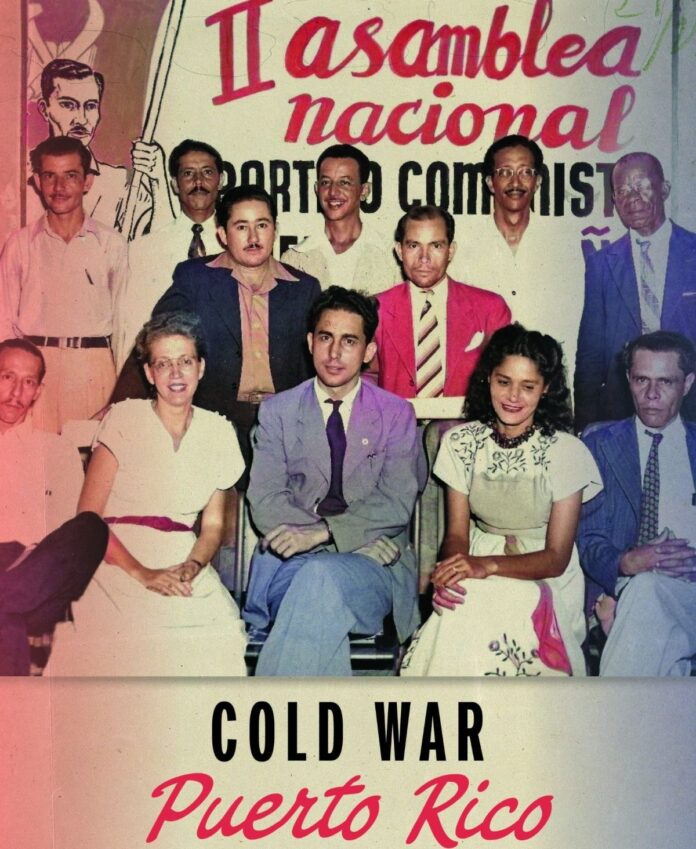
History always comes alive when written through the prism of personal experience. At just over 200 pages, Steve Howell’s Cold War Puerto Rico: Anti-Communism in Washington’s Caribbean Colony is a vibrant account of the struggle for Puerto Rican independence, his father Brandon Howell’s role in it and the huge efforts the United States’ FBI put into surveilling and disrupting the independence movement. It is well worth a read.
Brandon Howell died in 1987, aged 69, of a recently diagnosed brain tumour that left him with little time or capacity to describe to his son his significant role in the Puerto Rican workers’ movement. Cynthia, Brandon’s second wife, sent her son Steve up to the attic to look at boxes of files Brandon had kept about his time in Puerto Rico. “It was as if another person was hiding up there,” Howell recalls.
Born in New York in 1918 to US Christian Scientist parents, Brandon Howell became an architect, town planner, writer, editor, cartoonist and communist organiser and leader in Puerto Rico in the 1940s. He went to Chile after graduating as an architect from UC Berkeley and it was his activities in Puerto Rico that made him a subject of interest to the FBI and the ‘red scare’ politics of the United States in the 1940s and 1950s.
Using the boxes from the attic as the foundation for years of research, requests and challenges under the US Freedom of Information Act to access heavily redacted FBI files, the author reconstructs his father’s crucial role in the independence movement between 1941 and 1948. In 1949, Brandon’s first wife Bee, who wanted him “to forget his radical political beliefs” and the pressures it forced them to live under, persuaded Brandon to leave for London to start a new life and a degree at the LSE. Yet the FBI surveillance continued for decades after his departure from the island, with MI5 playing the role of willing helper.
While at the heart of the rationale for the account, Brandon Howell’s role is put into perspective by portraits of the many key figures in the Puerto Rican independence movement. Among them were César Andreu Iglesias, a communist activist for 40 years and his partner and collaborator, Jane Speed, who met Iglesias in the US and later shared a home on the island.
Speed had come to the FBI’s attention by organising an unauthorised, integrated May Day march in Birmingham, Alabama, facing down the Klan and its allies in the US police. Howell, Speed and Iglesias spent a decade working together for a socialist and independent Puerto Rico alongside other members of the Puerto Rican Communist Party and independence movement.
The FBI, under the leadership of J. Edgar Hoover, had been at war with communism since the 1930s. By 1940, Hoover and his team had begun to shape the narrative of the ‘red scare’ a decade before senator Joseph McCarthy jumped on the bandwagon. The author suggests that “it is arguable that Hooverism is a more accurate epithet than McCarthyism” for the witch-hunts that gripped US politics for a decade. The ‘red scare’ did not stop at the borders of the United States; independence movements in the western hemisphere were a central concern of the US government.
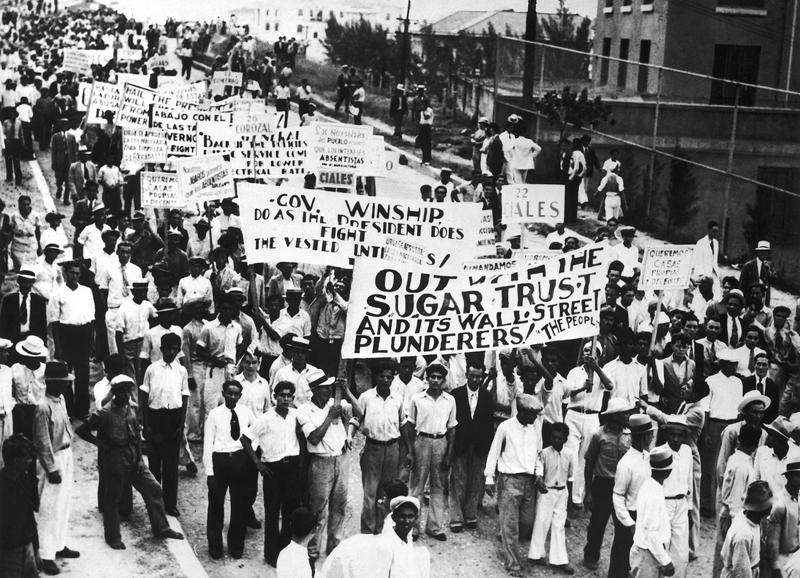
The struggle for Puerto Rican independence and the US strategic opposition to it forms the political core of the book. Communist and independence activists were surveilled by the FBI in Puerto Rico. The Gag Law (Ley de la Mordaza), Puerto Rican legislation that mirrored the US anti-communist Smith Act, was initially used to suppress dissent. In later periods, the FBI resorted to a more sophisticated playbook born of decades of international experience, such as exploiting political differences within Puerto Rico’s left and using personal information to blackmail and immobilise the political opposition.
These efforts only intensified with the advent of the Cuban Revolution in 1959 – a monumental event in the Americas that put US imperialism on the back foot. It is estimated that detailed files were kept on 15,000 Puerto Ricans, a staggering number for a population of two and half million people. As part of this operation, the FBI spent years trying to pin down exactly what Howell’s role was in the Puerto Rican Communist Party and whether Howell was the same person as Diego Muñoz, a socialist cartoonist whose output featured in the Puerto Rican left-wing press. He was.
The FBI eventually obtained a good picture of his activities when his first wife, Bee, gave written testimony to the FBI in August 1950, a year after their divorce, following a tip-off from the psychiatrist she had been under treatment with. The move to London had only served to magnify the differences between them and for her psychiatrist, a Dr Baumgardner, the strategic interests of the United States trumped patient confidentiality.
The book outlines in detail how Puerto Rico has, to this day, never been an independent state; its ‘Commonwealth’ status being the sleight of hand used to maintain US domination of trade, governance and the US military presence. However, Howell describes how Commonwealth status allowed activists to successfully challenge the legal basis for the House Un-American Activities Committee’s work on the island, with the help of a large mass movement that sent the senators packing with their tails between their legs in 1959.
Alas, publication came just too early to discuss the kidnap of president Maduro, which revealed the strategic military significance that Puerto Rico still holds for the US. Post-cold war mothballed military sites were dusted off and sprang into operation in the build-up to Maduro’s capture. As Manuel Quiñones wrote in Politico: “To get to Maduro, Trump went through Puerto Rico.”
As the US resists its decline into a multipolar world following its defeat in the Middle East, it is likely that the fate of Puerto Rican independence will be tied ever more securely to the desire of the US to hold on to power in its hemispheric backyard. David versus Goliath is not an epithet used by the author of this excellent book, but it seems appropriate to me.
Cold War Puerto Rico: Anti-Communism in Washington’s Caribbean Colony by Steve Howell is published by University of Massachusetts Press. Order it for the special price of £20 including postage (Britain and Ireland) from the Steve Howell website.
Subscribe to our regular updates to receive the latest articles, analysis and news direct to your inbox at https://theleftlane.media/subscribe/