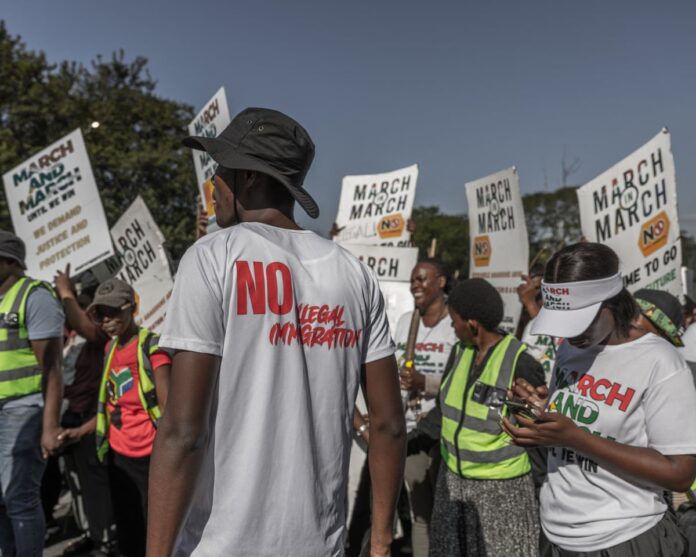
South Africa is in the grip of a wave of xenophobic attacks against foreigners from other African countries. Angry mobs have been terrorising foreigners, preventing them from getting health care and trying to force children out of government schools. In the southern coastal town of Mossel Bay, at least two Mozambicans have been killed.
Violent xenophobia is not new. It first appeared in 2008, when a wave of violence broke out in Alexandra, a poor Johannesburg township, spreading across the country, 62 people were killed, including 21 South Africans. A report into the violence concluded that apart from national chauvinism, it had strong roots in frustration borne out of continuing poverty, despite the democratic transition of 1994.
After 1994, many migrants from Mozambique, Zimbabwe, Malawi and the Democratic Republic of Congo (DRC) had moved into South Africa. The economic meltdown in neighbouring Zimbabwe had led to thousands of Zimbabweans crossing the Limpopo River into South Africa. Small traders from Somalia, Ethiopia, Pakistan and Bangladesh had also established themselves in poor townships, often undercutting their local competitors.
Since 2008, there have been recurrent waves of anti-migrant violence, increasingly triggered by local politicians, including the Zulu king in 2015.
The ruling ANC has a proud non-racial and anti-ethnic tradition. When it came to power in 1994, many of its leaders were white, Indian and coloured (to use South African terminology). But since then, as a strong wealthy middle-class African elite has grown, the party has become increasingly Africanist. The ANC government, increasingly out of touch with ordinary citizens and fearful of the popularity of xenophobic attitudes, has failed to come out strongly and consistently against xenophobia.
Some more recently established parties are stridently anti-foreigner. The rhetoric is often phrased at opposition to “undocumented” migrants. Public figures deny being xenophobic, saying they are concerned about uncontrolled borders and the numbers of foreigners living in the country, using social services, but without any legal status.
The police have following up cases of extreme violence, but arrests and conviction rates are low. The police force itself exercises anti-migrant campaigns. Several inner-city areas with dilapidated buildings and local drug gangs, have significant migrant communities. In the name of law enforcement, police regularly raid these communities, checking for criminality but also checking identity documentation and arresting those without legal status. This is starkly reminiscent of the old apartheid pass law raids, in which Africans without passes to live in ‘white’ towns were arrested and sent back to their ‘homelands’.
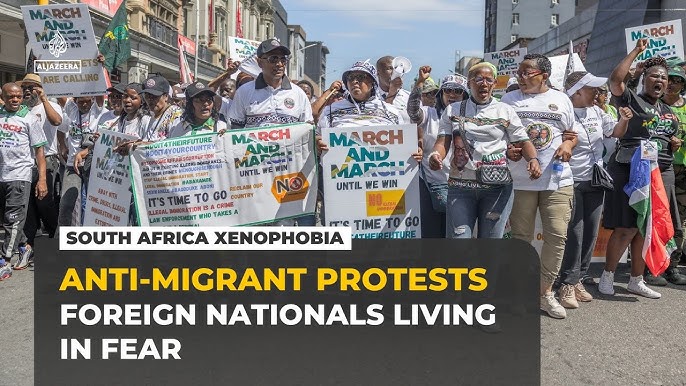
Leaders of African countries whose citizens have been targeted have expressed indignation against violence against their citizens. South Africa’s president Cyril Ramaphosa has routinely condemned violence, although one of his ministers has proclaimed that: “There are no xenophobic attacks in South Africa. There have been attacks on foreign nationals, which is unfortunate and law enforcement has to do their work.”
The organised left in South Africa, which opposes xenophobia, is extremely weak and is in no position to mobilise mass solidarity with foreign Africans. Indeed, some unions themselves have become bases used by the organised chauvinists. Using the power of social media, anti-migrant groups have become increasingly more organised, with a number of them now actively campaigning against ‘illegal’ foreigners. These organisations have declared that all undocumented immigrants must leave the country by 30 June.
Ramaphosa’s response has been to promise to strengthen enforcement of immigration laws. Fearful of widespread violence and chaos, the government will no doubt mobilise the police to keep order after the 30 June deadline. But without the government taking a strong line against xenophobia, the country is sinking further into hateful nationalism.
There was some hope offered by a summit that took place from 29-31 May 2026, under the banner of “Conference of the Left”. The summit was convened by the South African Communist Party (SACP) and included two major political parties, trade unions and a collection of other parties and groups.
The statements from the conference were unequivocally critical of the xenophobia and the scapegoating of foreign nationals, correctly pointing to unemployment and lack of reliable services as the major problems facing the poor.
Although the conference, which was well funded, decided on forming a permanent “Council of the Left”, its constituent organisations are united primary by opposition to the ANC. The declaration from the conference appeared to be strongly influenced by the SACP, containing calls for a policy on unemployment and the adoption of alternative macro-economic models to the liberal framework of the ANC-led ‘Government of National Unity’.
The local government elections later this year, which the three largest parties in the Council of the Left will contest, will show the extent to which a common front between a widely divergent range of political parties will be possible.